Posts tagged ‘Scripture’

April 12, 2024

Discerning the Times

It has been said that we must know where we have been in order to understand where we are going. The canon of Scripture provides us with a God-breathed historical record of His covenantal decree from creation to consummation. Exhibit A below visualizes this:
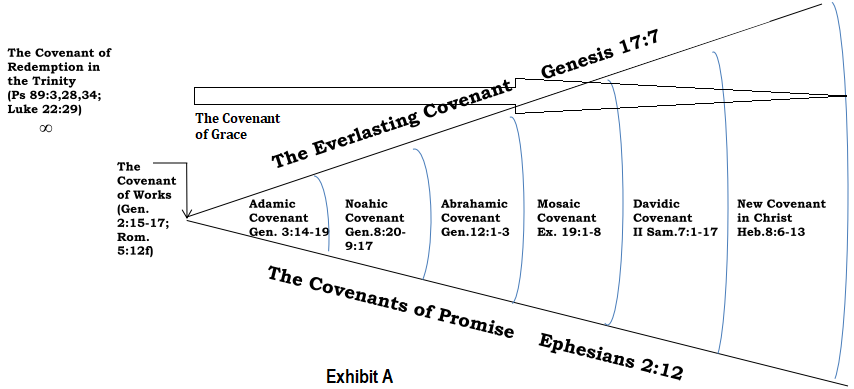

Biblical scholars have recognized distinct periods in the life and times of God’s people as chronicled in holy writ. The timeline shown below (Exhibit B) delineates fifteen historical periods:


As our understanding of time and history continues to grow, even as we grow in grace and knowledge of our Lord and Savior Jesus Christ, the historical periods of the Bible may be expressed thusly, with sixteen historical periods leading to the eternal state, as per Exhibit C:


Exhibit B omits the historical period from the Lord’s ascension to the “days of vengeance” (cf. Luke 21:22) which is distinctly identified in the Scriptures (e.g. Daniel 9:26-27), and is the particularly frequent subject of New Testament prophecy. The omission of this period ignores the Lord’s prophetic focus on the generation then living. Dispensationalist / sensationalist influence may have led to extending those last days throughout the entire church age (millennia) up until the second coming, with the end of them somehow being continually imminent.

Exhibit C properly distinguishes the last days of the old covenant age with its animal sacrifices, etc., that finally passed away with the destruction of the temple in 70AD. The new testament corpus is irrefutably clear on this: the last days were then, as the end was at hand. Not the end of time as written of in 1 Corinthians 15:24 which takes place upon completion of the church/gospel age; but rather, the end at hand was the passing away of the “heaven and earth” of the old covenant age (cf. Isaiah 51:15-16).

Applying “last days” to the church age is more and more problematical as sensationalist predictions have failed to materialize for almost two millennia so far; besides which the Lord Jesus Christ, who is reigning now, must reign until all His enemies are under His feet (cf. 1 Corinthians 15:25) before the end comes.

This historical interpretation does not represent a novel understanding, and in no way denies or sets aside the creedal doctrines of the second coming of Christ at the end of time for the universal resurrection of bodies and eternal judgment for all who ever lived.  As the church continues to shuffle off the “we are now living in the last days” paradigm, the words expressed by astute theologians are beginning to gain traction towards this biblical understanding:

Here’s Albert Barnes from his commentary on Hebrews 6:5: …and have tasted the good word of God and the powers of the age to come…:

the powers of the world to come – Or of the “coming age.” “The age to come” was a phrase in common use among the Hebrews, to denote the future dispensation, the times of the Messiah…

Here it evidently refers to that period, and the meaning is, that they had participated in the special blessings to be expected in that dispensation – to wit, in the clear views of the way of salvation, and the influences of the Holy Spirit on the soul.

The word “powers” here implies that in that time there would be some extraordinary manifestation of the “power” of God. An unusual energy would be put forth to save people, particularly as evinced by the agency of the Holy Spirit on the heart. Of this “power” the apostle here says they of whom he spake had partaken. They had been brought under the awakening and renewing energy which God put forth under the Messiah, in saving the soul. They had experienced the promised blessings of the new and last dispensation; and the language here is such as appropriately describes Christians, and as indeed can be applicable to no other.

Here’s John M. Buttrey II from his brief commentary on Revelation:

The last days are not a future period of time leading up to the rapture of the church and the end of the world. Nor are the last days describing the full contemporary Christian era. It hardly seems consistent to associate the term “days” with two millennia of years! A closer look at the New Testament usage of the term will reveal that the last days represented a now historical period of time. It was a fitting description of the final days of the Old Covenant, a period lasting a little over forty years. The first century earthly ministry of Jesus ushered in these last days. In this way, the “last days” of the New Testament were actually the “first days” of the New Testament church.

And here’s Milton Terry, excerpted from Biblical Apocalyptics:

The period which preceded the coming of the Messiah was spoken of as this age; that which followed His [first] coming was the age to come.

…by this age they meant and could mean nothing else than the current period in which they were living, the then present age. The question of the disciples, as recorded [in Matthew 24:3], could therefore only refer to the pre-Messianic age, and its consummation was, as we have seen, associated in their thought with the overthrow of the temple. But even were it admitted that their notion of “the consummation of the age” was erroneous, the teaching of Jesus was emphatic beyond all rational question that that generation should not pass away before all those things of which they inquired should be fulfilled.

The age to come, the Messianic time, would accordingly be the period that would follow immediately after the termination of the pre-Messianic age. That time had not yet come when Jesus spoke. According to the whole trend of New Testament teaching that age and the Messianic kingdom were near or at hand. Christ’s ministry fell in the last days of an aeon.

Lastly here’s Ralph Bass, from his commentary on Revelation:

And He who sits on the throne said, “Behold, I am making all things new.” And He said, “Write, for these words are faithful and true.” The phrase, behold, I am making all things new (Rev. 21:5) is interpreted by most as the beginning of the eternal state. We posit a millennium, which moves the world increasingly toward this eternal state with the increasing victory of the Church, but does not ultimately confuse the one with the other. Symbolic language pictures our spiritual victories and looks forward to material benefits in earthly prosperity and health. But the earthly millennium is never to be confused with heaven itself.

The effectiveness of biblical apologetics as well as the fruitfulness of Christian cultural engagement efforts will be greatly enhanced by our increased discernment of the times, and our corresponding faithful witness to the truth of what has been, is now, and is to come; that the last days as written of in the New Testament are in our past, and that our commission as “the church militant” advancing the gospel under the authority of the Lord Jesus Christ, and by the power of the Holy Spirit, is clear.

The long haul to triumph will likely extend beyond the relatively short lifetimes of those of us alive today; there’s no time to waste. Let’s get busy using our talents in good and faithful service to our King (cf Matthew 25:23), leaving an example for future generations to follow. Keep the faith. Stand strong in the Truth.

~

Also see: Scripture References: The Gospel Age and The Eternal State

April 9, 2023

Eschatology Between the Extremes

golden-city

Background

Bible students (as all reformed Christians are) must be careful to distinguish among New Testament prophetic references to ”coming” (Greek: parousia) –– whether applicable to the end of the age in which they were written, or applicable to the end of the world at the end of time.1 That is, whether the correct interpretation of each prophecy is in the past or in the future, with respect to us in the present. Prophecies, by definition, of course apply to what was then the future at the time they were prophesied; the question is: whether they were fulfilled in our past (already), or are still in our future (not yet).

The destruction of the city of Jerusalem and the Jewish temple in 70 AD was clearly the fulfillment of the Lord’s prophecy rendered in the Olivet discourse of Matthew 24 (and parallels) during the time of His humiliation. The desolation of the temple capped off the end of the old covenant age. Those were “…the days of vengeance, that all things which are written may be fulfilled” (Luke 21:22) 2.

The destruction of the city of Jerusalem and the Jewish temple in 70 AD was clearly the fulfillment of the Lord’s prophecy rendered in the Olivet discourse of Matthew 24 during the time of His humiliation. The desolation of the temple capped off the end of the old covenant age. Those were “…the days of vengeance, that all things which are written may be fulfilled” (Luke 21:22) 2.

The coming of our Lord Jesus Christ encompassed His incarnation, ministry, crucifixion, resurrection, ascension to His millennial reign, and judgment of apostate Israel including those who called so vehemently for His crucifixion (Luke 23:21). The destruction of Jerusalem and the temple was the sign of His exaltation; the vindication of His identity as Christ, just as He had foretold before being condemned to death (Matthew 26:64; Mark 14:62).

There can hardly be any doubt that the book of Revelation was written prior to 70 AD, as from our historical perspective, the events which happened then manifestly align with the things signified to John in the Apocalypse shortly before they were to take place (Revelation 1:1; 22:6). The questionable “evidence” of a quote attributed to church father Irenaeus simply does not sustain a later date of its writing, which has been propounded as the majority report.3

Even so, the 1st coming of Christ and His finished work on the Cross in 30 AD is the pivotal focus of all of Scripture. Our glorified Lord’s reign has continued since His Ascension, well beyond 70 AD to the present day, unless the “millennium”4 (the time of Messianic reign) was only 40 years.

The Lamb of God rose from the dead 3 days after His crucifixion; 40 days after that the Son of Man ascended (“…came up to the Ancient of Days…” per Daniel 7:13 [NASB]) and has been reigning ever since.

This selfsame divine Person (“…and His name will be called Wonderful, Counselor, Mighty God, Everlasting Father, Prince of Peace.” –Isaiah 9:6), the King of kings and Lord of lords, Jesus Christ, is reigning now! He will continue to reign in heaven and by His Spirit in His people until …the end, when he delivers the kingdom to God the Father after destroying every rule and every authority and power. For He must reign until He has put all enemies under His feet (1 Corinthians 15:24-25).

The 2nd coming of the Lord which will happen then (the end of time) is still in our future (cf. Hebrews 9:28).

The invisible “coming” of the Son of Man in wrathful judgment upon that wicked generation in 70 AD is certainly a frequent prophetic reference in Scripture as an outworking of the signal events of 30 AD; nevertheless “…it has not yet been revealed what we shall be, but we know that when He is revealed, we shall be like Him, for we shall see Him as He is” -1 John 3:2. A few verses earlier John exhorted believers to abide in the Lord with perseverance, so as not to be ashamed before Him at His coming (1 John 2:28). This is a clear reference to the final judgment of each individual after death, when everyone must give account personally (cf. Hebrews 9:27; Romans 14:10-12).

The Extremes

Rather than studying to arrive at an interpretive understanding of Bible passages according to context in light of the full counsel of Scripture, one extreme school of thought automatically relegates all “coming” passages to a preterist (fulfilled in our past) interpretation. At the other extreme, another school of thought presupposes “coming” passages to have a futurist (still in our future) interpretation. The all-preterist system can be called pantelism5; the hyper-futurist hermeneutic is adhered to in the system commonly known as dispensationalism.

Dispensationalism, considered to be “losing steam” more and more in recent decades, was propagated with the publication of the Scofield Reference Bible at the beginning of the 20th century. It refuses to accept at face value the text of Matthew 24:34“Assuredly, I say to you, this generation will by no means pass away till all these things take place.” The events including the “great tribulation” (Matthew 24:21) and the coming of the Son of Man in judgment to destroy the temple (Matthew 24:30), which happened leading up to and in AD 70, are among “all these things” spoken of by our Lord in the text. Furthermore, dispensational futurism does not allow for the many time texts such as “soon”, “at hand”, “near”, “coming quickly”, etc., employed throughout the New Testament, to apply according to the standard usage of those terms. Rather, almost 2,000 years (so far) are arbitrarily added to the interpretations in order to keep the occurrence of the predicted events in our near future. This provides for a continuingly impending end times perspective that may be sensational, but it just doesn’t make good sense. Besides, any interpretation that makes the text to have been meaningless or misinforming to the original audience must be rejected.

Pantelism may be seen as an overreaction to dispensationalism. Pantelism presupposes that all prophetic passages must have a preterist interpretation, inclusive of references to the resurrection of the body and the final judgment. With pantelism, the end of the old covenant age was the consummation of all things, and we are in the eternal state now. According to this thinking, the Lord’s still future descent from heaven (when the dead rise and the living are caught up together with them in the clouds) written of in 1 Thessalonians 4:16, which corresponds to His Ascension depicted in Acts 1:11, somehow already happened and was not a physical event. There is a variety of explanatory particulars amongst the system’s adherents as to how that is reconciled with the Lord’s clearly physical Ascension, when the angels testified that He will come “in just the same way” (Greek hos tropos) as he was seen taken up.

Even recognizing the eschatology of the New Testament as predominantly preterist, elevating the events of 70 AD over and above the events of 30 AD in their redemptive-historical significance is problematical to say the least. Denial of the future, bodily 2nd coming of the Lord Jesus Christ to physically resurrect the dead and eternally judge all who ever lived puts pantelism outside the bounds of Christian orthodoxy.

While the outright erroneousness of both of these extremes may be apparent to seasoned students of Scripture, many of today’s Christians have grown up under dispensationalist teaching, which has been popularized in the modern culture by best-selling books and movies such as the “Left Behind” series. Others, who have become disenchanted with dispensationalism, may have been swayed by pantelism as a seemingly logical alternative; but while pantelism eviscerates the interpretive errors of dispensationalism, the arbitrary misconceptions inherent in pantelism are just as bad to the other extreme, and even worse.

“Consistent”

The interpretation of any particular passage of Scripture is informed by the context, over and apart from the understanding gleaned from the usage of similarly framed wording in a different context. To presume otherwise leads unswervingly to a fundamental misunderstanding of the Bible, which is certainly not so simplistic as to apply the same meaning for a word or phrase every time it is used. The same word(s) or phrase(s) may have differing meaning, usage and interpretation in different instances (this especially calls for discernment interpreting the connotation of the word “coming”), depending upon the context . This simple hermeneutical principle may seem to be very basic and easy to understand, yet the failure to grasp it, or to override it with a presupposition of forced “consistency” has become a stumbling block to deriving sound, balanced counsel from God’s word, which unavoidably leads to one erroneous extreme or another.

As noted above, in the Olivet discourse of Matthew 24, the Lord foretold in verse 34 that “all these things” would take place before the passing away of the generation then living. So contextually “all these things” must apply to those stated in the preceding verses of that discourse.

In the passage in Matthew 16 beginning with verse 24 where the Lord’s “take up your cross and follow Me” teaching is recorded, Jesus encourages His disciples to self-denial through sufferings, by comparing worldly afflictions with eternal life (cf. Romans 8:18), and associating material gain with loss of immortal soul. In that context comes verse 27:

“For the Son of Man will come in the glory of His Father with His angels, and then He will reward each according to his works”.

This verse sets forth the weighty consideration of the millennial reign of the Lord Jesus Christ in heaven commencing with His coming up to the Ancient of Days (cf. Daniel 7:13, NASB) to sit in judgment over everyone and everything through to the final consummation of the kingdom when all His enemies are under His feet… see this.

Then follows verse 28:

“Assuredly, I say to you, there are some standing here who shall not taste death till they see the Son of Man coming in His kingdom.”

In this verse Jesus assures them that His coming into His kingdom is about to be manifest, before some of them die, by His ascension to heaven, the pouring out the the Holy Spirit at Pentecost, the establishment of the church, the preaching of the gospel, and the events leading up to and including the great tribulation of Jerusalem with the utter destruction of the old covenant temple marking the end of the age.

The Lord was teaching His disciples that the new covenant age was at hand, to come within that generation, finally with the apocalyptic judgment upon apostate Israel as a sign of the ascended Son of Man in heaven per Matthew 24:30:

“…and then shall appear the sign of the Son of man in heaven: and then shall all the tribes of the earth [land] mourn, and they shall see the Son of man coming on the clouds of heaven with power and great glory” (ASV).

The process of the Lord ruling in the midst of His enemies being put under His feet (cf. Psalm 110:2; 1 Cor. 15:25) was at hand – the inauguration of the Messianic kingdom culminating with the complete destruction of the temple, ending the old covenant sacrificial system.

While the prophesied events heralding the inauguration of the new covenant were near at hand then, they are no longer on the horizon now. Even so, “the end” for everyone alive remains imminent to this day with respect to physical death (cf. Hebrews 9:27, Romans 6:23 and Luke 12:16-20), as the Lord continues to judge the nations and reward each individual according to his works, until the end of time when the last enemy that will be destroyed is death (1 Cor. 15:26).

Notes

What was the “age to come” for the New Testament writers is the age we are living in now, the gospel age, the new covenant age which began as the old covenant age passed away. The New Testament was written in the “last days” of the old covenant. We won’t be in the eternal state until the end of the present age which will be the end of time & history.

The Lord here references Old Testament prophecies of the destruction of Jerusalem and the temple, most notably Daniel 9:26 .

For a thorough, scholarly exposition in support of a pre-70AD date for the composition of the book of Revelation see Kenneth L. Gentry’s Before Jerusalem Fell.

The millennium is a reference to “a thousand years”, mentioned in Revelation 20 as the period of Christ’s interadvental reign. Postmillennialism (that the Lord’s 2nd Coming must be after His Messianic reign) is assumed here. Amillennialism is technically postmillennialism as far as timing; differing in the expected nature of the millennium. Premillennialism (that the Lord’s 2nd Coming must be before the millennium to set up His reign on earth) is the view routinely adopted by dispensationalists.

The term pantelism (from the Greek words for “all” and “fulfilled”) was coined by C. Jonathan Seraiah, who has written an excellent refutation of the viewpoint (see The End of All Things: A Defense of the Future). The label pantelism (instead of hyper- or consistent preterism) is a neutral term that does not use the pejorative “hyper” prefix nor define non-pantelist preterism as somehow “inconsistent”. Here is an excerpt from an editorial intro for Pastor Seraiah’s highly recommended book: The easiest way to deal with false doctrine is to affirm its absolute opposite. Unfortunately, this opposite affirmation is often no less erroneous than the false doctrine against which it reacts-sometimes, it is worse. Most conservative Christians in the twentieth century have been obsessed with “the last days.” An absolute opposite answer has recently emerged in the form of what C. Jonathin Seraiah terms “pantelism,” the view that all final events had taken place by the destruction of Jerusalem in A.D.70. With one fell swoop, this viewpoint eviscerates dispensationalism. Unfortunately, it also undermines orthodox Christianity.

~

May 27, 2022

HIStory, the Here & How, and the Hope of Heaven

Sometime around 1,992 years ago the resurrected Lord Jesus Christ ascended with the clouds of heaven up to the Ancient of Days (cf. Daniel 7:13). Having been conceived by the Holy Spirit and born of the virgin Mary, He left the glories of heaven and came to this sin-cursed earth, took on flesh and lived a sinless life — obedient to the Father unto death, even death on a cross. For He made Him who knew no sin to be sin for us, that we might become the righteousness of God in Him (2 Cor. 5:21).

What a miracle of love: God became a man! That part of the blessed work of redemption, as determined since before the foundation of the world by intraTrinitarian Covenant (pactum salutis) was accomplished in the fullness of time, in accordance with divine decree. Christ came forth, to faithfully perform the atonement for the sins of His people, as typified in the Old Testament, by perfect righteousness and substitutionary propitiation; as He proclaimed upon the cross, “it is finished.”

The third day thereafter He rose from the dead, and that calls for a never-ending chorus of hallelujahs. It behooves us to rejoice as we faithfully meditate upon the blessed historical truth of the Holy Spirit inspired Scriptures. Worthy is the Lamb of God Who was slain. All praise and glory to God Who is blessed forever, amen.

With the glorified God-Man reigning at the right hand of Majesty on High, the Holy Spirit, who proceeds from the Father and the Son, regenerates sinners to new life in Christ Jesus; comforts, counsels and empowers His people, and seals us for the day of redemption. How then should we live? Never forget that we’re now spiritually alive and well, with the Spirit Himself dwelling within us. Therefore, not only are you a part of His body which is a living temple, but also your body itself is a temple! Mindful of being thus set apart as Holy, we pray for God’s will to be done on earth as it is in heaven. We are no longer slaves to sin, but rather bond servants of Jesus Christ. Let us go forth, not on our own strength, but abiding in Him, obeying His commandments. This indeed is a most gracious gift from above. For the fruit of the Spirit is love, joy, peace, patience, kindness, goodness, faithfulness, gentleness and self-control (Galatians 5:22-23).

In light of all this, zeal for God’s glory ought to burn within us, as the Holy Spirit quickens us and fans the flames within our souls! Indeed, man’s chief end is to glorify God, and how better to effectuate that purpose than to bring every thought, word and deed captive to Christ. His kingdom is advancing on earth, and we are the instruments. Inaugurated in the 1st century, the kingdom of heaven has expanded by the millions in Africa and Asia and throughout the world. The Christian foundation of the American experiment may be crumbling, but we must think globally and long term. Besides, we walk by faith and not by sight (2 Cor. 5:7).

So with our reigning Lord Jesus as the Head over all things, and us as the members of His body, the feet should be moving and the hands reaching out, the tongue speaking… we may not see it in our generation; even so, ours is not to sit back, wait, watch or complain about what Jesus is doing or not doing. We are what Jesus is doing!

After declaring “All authority has been given to Me in heaven and on earth” … the next word our Head says is “Go”… go therefore and make disciples of all the nations, baptizing them in the name of the Father and of the Son and of the Holy Spirit, teaching them to observe all things that I have commanded you; and lo, I am with you always, even to the end of the world(Matthew 28:18-20). Amen.