Posts tagged ‘prophecy’

September 4, 2024

Glory in the Highest – He Reigns

by Gordon Graham | Updated Sep 4 2024

The living, active word of God brings continual refreshment and renewal to our understanding as we seek to perceive its meaning in the historical context so as to rightly determine the application looking forward from there.

“For the Son of Man will come in the glory of His Father with His angels, and then He will reward each according to his works. –Matthew 16:27

In his commentary on this passage, Adam Clark wrote:

This seems to refer to Daniel 7:13-14:

“I kept looking in the night visions, and behold, with the clouds of heaven One like a Son of Man was coming, and He came up to the Ancient of Days and was presented before Him. And to Him was given dominion, glory and a kingdom, that all the peoples, nations and men of every language might serve Him. His dominion is an everlasting dominion which will not pass away; and His kingdom is one which will not be destroyed.” [NASB]

This was the glorious Mediatorial kingdom which Jesus Christ was now about to set up, by the destruction of the Jewish nation and polity, and the diffusion of His Gospel through the whole world… It is very likely that the words do not apply to the final judgment, to which they are generally referred; but to the wonderful display of God’s grace and power after the day of pentecost.

-Adam Clarke’s Commentary on the Bible | Adam Clarke, LL.D., F.S.A., (1715-1832) | Published in 1810-1826; public domain.

The context is the Lord’s “take up your cross and follow Me” teaching. Jesus encouraged His disciples to self-denial through sufferings, by comparing worldly afflictions with eternal life (cf Romans 8:18), and associating material gain with loss of immortal soul.

Then He foretells that He is “about to” [μέλλει / mellei] ascend to His throne in heaven where He sits at the right hand of the Father to “repay every man according to his deeds” as He did with the “days of vengeance” judgment on apostate Israel via the Roman armies in 70AD; and He continues to judge the world throughout His millennial reign until He has put all enemies under His feet. (cf. 1 Cor. 15:25).

Psalm 2 tells of the Messiah’s triumph and kingdom (note that in verse 6, by Zion is meant the church of God, especially in the gospel age under the New Covenant (cf. Heb. 12:22).

Gary DeMar’s analysis is helpful:

When these soon to take place judgments happened, God’s judgment was neither postponed nor stopped. They serve as warnings as Paul stated in 1 Corinthians 10:11: “Now these things happened to them [Old Covenant Israel] as an example [τύπος/type], and they were written for our instruction, upon whom the ends of the ages have arrived.” The “our instruction” refers to the people in Paul’s day related to the upcoming judgment on first-century Israel that took place in the lead up to and including the destruction of Jerusalem that happened in AD 70. All generations can learn from Israel’s moral mistakes as well as the moral mistakes of Rome, the French Revolution, the Soviet Union, Nazi Germany, and modern-day United States. No one is exempt from God’s judgment.1

Understanding Matthew 16:27 as referring to our Lord’s glorious ascension up to the heavenly Session of His millennial reign better reconciles the historical context with ongoing future application than does considering it solely in reference to either the days of vengeance now past, or to the future 2nd Coming at the end of time.2 In Acts 1:9, Jesus is described as being taken up into heaven on a cloud, which parallels the imagery in Daniel 7:13.

The inauguration of the resurrected, glorified Christ’s reign in heaven at His ascension takes into account the “already / not yet” aspect of fulfilled prophecy, while also recognizing that God’s judgment was not only in 70AD but is continuous throughout time and history until the consummation of all things.

Here’s additional insight from Gary DeMar:

It is important to note that the noun “preterism” has been squeezed too far back as if it is about nothing more than what is past, about completed action in the past with no future application. The New Testament does address the issue of preterism and acknowledges that certain prophetic announcements—such as Christ’s Olivet Discourse—have been fulfilled in the past. But there is more to consider. There is an important nuance that needs to be spelled out.

Let us get at it this way: Per the Greek, which verb tense best expresses what preterism is as the New Testament understands it? Is it merely the way the noun “preterism” is defined in a standard dictionary as simply referring to the past tense or is it the way the New Testament defines it? Only referring to the past tense and nothing more than that is not the best way to define what Biblical preterism is. The most accurate verb tense in the Greek to render what Biblical preterism really is [is] the perfect tense.

What is the difference between the standard past tense and this perfect tense? Like the standard past tense, the perfect tense also speaks of completed action in the past, BUT the perfect tense has much more nuance to it: The perfect tense in Greek speaks of completed action in the past whose consequences continue into the future by way of application. This is what true Biblical preterism is. It is very important to grasp this distinction. True preterism does not pit the past against the future. Rather, Biblical preterism organically unites the past and the future.3

In his commentary on Luke 19:13, And he called his ten servants, and delivered them ten pounds, and said unto them, “Occupy till I come”, Benson insightfully brings out the perfect tense structure of the passage covering past, present and future application:

And said unto them, occupy till I come — till I return to take an account of the use you have made of what has been intrusted to your management. The spiritual sense is, use your endowments, gifts, and graces, with all your privileges and advantages, for the good of your fellow-creatures, and the glory of God, till I come to visit the nation; to destroy Jerusalem; to execute judgment on my enemies, and on those of my people in successive ages; to require your souls of you by death, and to judge mankind in the day of final accounts.

-Joseph Benson’s Commentary on the Old and New Testaments

The coming and kingdom of Christ are not facts of of the future only, but of the past, present, and future. The crafty deception that messianic prophecy remains unrealized and ever looming in our near future opposes the biblical truth of fulfillment in and by the Lord Jesus Christ. False teachers feed the expectation of a fleshy messianic kingdom yet to be established on earth in accordance with the plague of scofieldian dispensationalism which has infected the church at large, even as it is both exegetically absurd and spiritually apostate.

As the wickedness of the modern day Zionist state of Israel is being exposed, awareness of the satanic conspiracy known as the ‘New World Order’4 is increasing. Scales are dropping from eyes. A “red pill” antidote compiled to counter Zionism’s long-term, pervasive brainwashing is available here.

Let us speak truth to power as the Light of the world shines unto eternal day.


1 Gary Demar, Does Isaiah 13 Predict the ‘End of the World’?, Jan 9 2024

2 Gorphilus DeJesus, Eschatology Between the Extremes, Dec 11 2022

3 Gary DeMar, So What Do We Do Now?, Jan 3 2024

4 Makia Freeman, Is the New World Order a Jewish Conspiracy? No, it’s a Satanic Conspiracy, Oct 14 2019

—-

Gordon Graham is a Ruling Elder in the Presbyterian Church in America and Clerk of Session at Auburn Road Presbyterian Church in Venice, FL. Husband of one wife, father and brother of two each, and brother in Spirit of many, he also writes under the pen name of Gorphilus DeJesus.

—-

~

November 12, 2023

Time, History and Eternity

The above graphic depicts an understanding of the phrases “this age” and “the age to come”, in their biblical/historical context. This understanding underlies the proper perception of our present situation, and affects our eschatological outlook. Satan is NOT “the god of this age” that we are in now. He was “the god of this age” when Paul wrote 2 Cor. 4:4; Gal. 1:4; Rom. 16:20, etc. Jesus crushed Satan’s head and bound him in the first century, cf. Matt. 12:29; Luke 10:18; Rev. 20:2; etc. Not to say that the evil one is not still active other than in wholesale deception of the nations the way he was before, but the Lord Jesus Christ is reigning now! cf. Ps. 2; Ps. 110; Dan. 7:13-14; 1Cor. 15:25; etc.

An “age” is a period of time. There is no other age that will follow the present age of Christ’s mediatorial reign (what the New Testament, written prior to the termination of the Old Covenant age with the destruction of the temple, refers to as “the age to come”). We are now in the final age of time and history, as the ascended Lord Jesus Christ reigns in majesty on high at the right hand of the Father. 

Premillennialists claim that there will be another age after Christ’s Second Coming, when He will reign upon the earth for 1,000 years prior to the final judgment, with a variety of flavors espousing a rebuilt temple, multiple mass physical resurrections, etc., etc. which is all patently unbiblical. An older version of postmillennialism taught that there will be a separate “golden age” in time and history after the present age and before the Second Coming; proponents of that view may have acquiesced to the lack of scriptural warrant for it.

Against “the age to come” as eternity

Ephesians 1:
17 that the God of our Lord Jesus Christ, the Father of glory, may give to you the spirit of wisdom and revelation in the knowledge of Him, 18 the eyes of your understanding being enlightened; that you may know what is the hope of His calling, what are the riches of the glory of His inheritance in the saints, 19 and what is the exceeding greatness of His power toward us who believe, according to the working of His mighty power 20 which He worked in Christ when He raised Him from the dead and seated Him at His right hand in the heavenly places, 21 far above all principality and power and might and dominion, and every name that is named, not only in this age (aion) but also in that which is to come.* 22 And He put all things under His feet, and gave Him to be head over all things to the church, which is His body, the fullness of Him who fills all in all. (NKJV)

*Note: the age “which is to come” in Ephesians 1 can hardly refer to eternity without conflicting with 1 Corinthians 15:

22 For as in Adam all die, even so in Christ all shall be made alive. 23 But each one in his own order: Christ the firstfruits, afterwards those who are Christ’s at His coming. 24 Then comes the end, when He delivers the kingdom to God the Father, when He puts an end to all rule and all authority and power. 25 For He must reign till He has put all enemies under His feet. 26 The last enemy that will be destroyed is death. 27 For “He has put all things under His feet.” But when He says “all things are put under Him,” it is evident that He who put all things under Him is excepted.
*28Now when all things are made subject to Him, then the Son Himself will also be subject to Him who put all things under Him, that God may be all in all.

The Ephesians passage presents the ages of time/history; the passage in 1 Corinthians presents the end: eternity. Jesus’ ascension took place in what were the last days of “this age” for the writers of the New Testament. In this final age now present (the “age to come” for the N.T. writers), Jesus is still reigning from on High and by His Spirit indwelling His people, living stones in a living temple, His body. He also rules over the nations with a rod of iron. This being the situation decreed for “not only in this age but also in that which is to come”, neither age can refer to the hereafter, as by contrast, in eternity, we shall eat and drink with Jesus Himself (cf. Matthew 26:29)! Our Forerunner will no longer be “far above”, having put an end to all rule and all authority and power; and we shall be like Him, for we shall see Him as He is (1 John 3:2)! The position of Christ the head and his body/bride the church will, at the end (in the eternity of final glory), be manifestly changed from that of the here and now, the age of the church militant (referred to as “the age to come” in Ephesians 1).

Paul wrote in the last days of the old covenant age when the temple was still standing. The “age to come”, which was then at hand, is fully here now: the gospel age, the “millennium” of the mediatorial reign of King Jesus.

In those same last days of the old covenant age when the temple was still standing, shortly before He suffered under Pontius Pilate, was crucified, died and was buried; rose again from the dead; and ascended into heaven, Jesus said to the high priest: “I say to you, hereafter you will see the Son of Man sitting at the right hand of the Power, and coming on the clouds of heaven.(Matt. 26:64) The hereafter our Lord foretold is the termination of the old covenant economy with the destruction of the temple in AD 70, the final end of that age, the outworking of AD 30 when Christ made the once-for-all sacrifice of Himself; which was also foretold by the angel Gabriel to the prophet Daniel:

“And after the sixty-two weeks Messiah shall be cut off, but not for Himself; and the people of the prince who is to come shall destroy the city and the sanctuary. The end of it shall be with a flood, and till the end of the war desolations are determined. Then he shall confirm a covenant with many for one week; But in the middle of the week He shall bring an end to sacrifice and offering. And on the wing of abominations shall be one who makes desolate, Even until the consummation*, which is determined, Is poured out on the desolate.” (Daniel 9:26-27)

*i.e. the consummation of the ages, the transition from the Jewish to the Christian: the mediatorial kingdom of the gospel age, the final age before the end, the millennial reign of the risen, ascended Lord Jesus Christ as written of in Ephesians 1.


[click image to enlarge]

April 23, 2023

Fallacious Notions – Temporal Displacement


What if the same controligarchs behind the gaslighting of the general populace have intentionally corrupted the Church’s understanding of the word of truth — the Holy Scriptures? Their objective being the establishment and popularization of distorted theology towards the advancement of their globalist agenda and neutering the church militant. It was largely achieved via the publication of a Bible with explanatory notes presenting delusory interpretations of the text:

“…Cyrus Scofield, a forger, felon and trained lawyer, had been hired by the Rothschilds to write this dispensational reinterpretation of biblical events and Christian doctrine.” …

”The writing and promotion of “Scofield’s Reference Bible” was a massive effort to subvert true Christianity to serve Zionist/NWO interests…

“Throughout the 20th Century and with incredible support from the Rothchild controlled Oxford Press, various editions of Scofield’s Bible would actually create a new religion, Christian Zionism (Judeo-Christianity), altering words and meanings through deceptive footnotes.”

– Merlin L. Miller1

First published in 1909 and still available today, the Scofield Notes have systematized a fanciful, invalid exposition of Scripture, serving the agenda of wicked globalists the likes of which are now being exposed more and more as the great democide of the 2020s unfolds.

One minister who broke with Scofieldism described it as a “subtle, intriguing heresy”.2

Thankfully, the unscriptural teaching of a literal, earthly Jewish kingdom, with all the associated temporal deceptions (e.g. inserting a “gap” of time in to the seventy weeks prophecy of Daniel 9:24-27) has come to be largely rejected. Even so, erroneous understandings of Bible prophecy, exacerbated by dispensational seminary teachings and media sensationalism, remain ingrained in the church at large, to the detriment of the gospel’s advancement.

Not rightly dividing the Scriptures in their historical context has led to a general “temporal displacement” in the understanding of eschatology, typically manifested by removing passages from their native context, i.e. the time period when they were written, and interpreting them as if they are written contemporaneously to the generation presently living.

Thus, in the minds of many, near-at-hand prophecies which were fulfilled accordingly in that 1st century generation, have remained unfulfilled and somehow continually imminent for almost 2 millennia now.

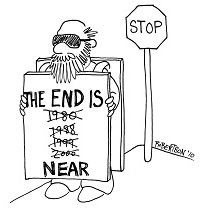
“The End is Near”

 “The end of all things” which was at hand when the apostle Peter wrote of it (1 Peter 4:7) refers, in its proper context, to the passing away of the old covenant as per Hebrews 8:13: In that He says, “A new covenant,”  He has made the first obsolete. Now what is becoming obsolete and growing old is ready to vanish away. The civil state of the Jews, their sacrifices, temple, city and nation would soon be gone. Of course, physical death, which is indeed the end of all things in this world, is always near at hand to any particular person, but the literal end of the physical world was clearly not near at hand nor in view in this passage.

Neither can the apocalyptic language of the book of Revelation prophesying the days of vengeance on the Harlot (apostate Judaism) and the Beast (Rome) be rightfully construed as foretelling an end of the cosmos at the end of time, since the events were foretold shortly before they were to take place (Revelation 1:1; 22:6). Just like the apocalyptic imagery of judgment in 2 Peter 3:10-13, the prophesied events were near-at-hand then.

Furthermore, the end of time is not near now. In this gospel age, the present millennial reign of our ascended Lord will continue until He puts an end to all rule and all authority and power. For He must reign till He has put all enemies under His feet (1 Corinthians 15:24-25). We rightfully expect that the earth will be filled with the knowledge of the glory of the Lord as the waters cover the sea (Isaiah 11:9; Habakkuk 2:14) before the end.

“Heaven and Earth will literally pass away”

The Bible teaches that, at the end of this church age, the presently bound Satan will be released for a short time (Rev. 20:3) to deceive the nations again and mount a rebellious army which is crushed as, in the apocalyptic language of the vision, “fire from heaven came down and consumed them” (Revelation 20:9). This does not mean that the creation itself will be destroyed by being burned up! The creation itself is being redeemed from the curse, not headed for dissolution, as it is written:

For the earnest expectation of the creation eagerly waits for the revealing of the sons of God. For the creation was subjected to futility, not willingly, but because of Him who subjected it in hope; because the creation itself also will be delivered from the bondage of corruption into the glorious liberty of the children of God. (Romans 8:20-21)

The crafty deception that the earth will be destroyed at the end of time is perhaps the most critical of all fallacious eschatological notions, and is at the root of many others.

Jesus’ statement that “Heaven and earth will pass away…” (Matthew 24:35) cannot be interpreted to refer to the physical cosmos without violating the analogy of faith, i.e. there can be no essential contradictions in the Scriptures. To wit:

The literal earth is determined to not pass away. In Psalm 104:5 David said that God “laid the foundation of the earth, that it shall not be removed forever.” And in Ecclesiastes 1:4 Solomon said, “One generation passes away, and another generation comes: but the earth abides forever.”

“And He built His sanctuary like high palaces, like the earth which He has established forever.” (Psalm 78:69).

“Praise Him, ye heavens of heavens, and ye waters that be above the heavens… “He has also established them for ever and ever: He has made a decree which shall not pass” (Psalm 148:4,6).

God promised after the flood that He would never again “strike down every living creature as I have done.” (Genesis 8:21). This, it is thought, does not rule out God’s destruction of the entire world by fire someday, and that 2 Peter 3:10 teaches this. But no, with the phrase “as I have done” the LORD attests to His power and majesty in His manner of declaration, not to give Himself a “loophole” to smite everything living again but in a different manner, which might be a laughable consideration if not so irreverently preposterous.

It would be a blatant contradiction if God was to burn up the elements, meaning atoms & molecules according to the literalistic misinterpretation of the prophetic language of 2 Peter 3:10.3  Besides, the apocalyptic destruction Peter wrote of was near at hand when he wrote in the last days of the old covenant.

Thus in light of the full counsel of Scripture, our Lord’s statement that “heaven and earth will pass away” cannot be interpreted literally in the context of Matthew 24:35. Rather, especially in consideration of the prophetic idiom being used, the reference is to the old covenant and its temple system (the house left desolate) just as it is in 2 Peter 3:10.

Jesus had also said “…assuredly, I say to you, till heaven and earth pass away, one jot or one tittle will by no means pass from the law till all is fulfilled.” (Matthew 5:18). The ceremonial ordinances were finally abrogated when the temple was destroyed, the Lamb of God having fulfilled all of the sacrificial typology.

Conclusively, the reference to the “passing away of heaven and earth” must be considered in light of the establishment of that same “heaven and earth” in Isaiah 51: 15-16:

”I am the LORD your God, Who divided the sea whose waves roared — The LORD of hosts is His name. And I have put My words in your mouth; I have covered you with the shadow of My hand, That I may plant the heavens, lay the foundations of the earth, and say to Zion, ‘You are My people.’”

The LORD was not depicting the original physical creation 3,000 years previously, but rather the establishment of the old (Mosaic) covenant upon bringing His people out of Egypt. (cf. Jeremiah 31:32).

“The Great Tribulation is Yet to Come”

Great tribulation may indeed be expected for present and future generations, especially as God’s people stand for the truth of God’s word in a culture of decadence and tyranny. Even so, Jesus’ prophecy that then there will be great tribulation, such as has not been from the beginning of the world until now, no, and never will be (Matthew 24:21) was declared in no uncertain terms to take place before the generation then living would pass away.

The book of Revelation, which apocalyptically presents the undiluted wrath of God poured out on that wicked generation, was written by the apostle John as a fellow partaker in that tribulation with the original hearers of the letter (Rev. 1:9). From our historical perspective, the events which happened then manifestly align with the things signified to John in the Apocalypse shortly before they were to take place as per the “temporal bookends” of Rev. 1:1 and Rev. 22:6.

The works of Jewish historian Josephus document the events of the great tribulation which took place in the time leading up to and including the destruction and desolation of the old covenant temple in 70 AD.

For a concise, highly readable record of those now historical events see George Halford’s The Destruction of Jerusalem. Judgment fell heavily upon that generation in those “days of vengeance” in vindication of the Lord Jesus Christ.

“No one knows the day or hour”

When predicting His coming in judgment (via the Roman armies) on apostate Judaism, the Lord stated, “But of that day and hour no one knows…” (Matthew 24:36). This He declared not in reference to His Second Coming at the end of time, rather, in context, the reference is to the day and hour of His near coming in judgment of which He was prophesying.

No one knew exactly when the Temple would be utterly destroyed and the Jewish age of sacrifice finished. But they were given warning signs:  when you see Jerusalem surrounded by armies, then know that its desolation is near (Luke 21:20) and more importantly, the general time by when it would take place: within that generation!

While it is true that the day and hour of the Second Coming of Christ (cf. Hebrews 9:26-28) remains unknown to mankind, the temporal markers in the text of the Olivet discourse in Matthew 24 (and parallels) do not authorize direct application of the saying to that great, final, end-of-time event which Christians ought to hopefully expect in accordance with God’s timetable, when all His enemies have been put under His feet, which may not happen within the lifetimes of anyone reading this now.

Not to dare prognosticate on this matter, but it looks like a long term proposition, as God gathers in the multitudes of His elect. Let us hasten the day by advancing the gospel that it may flourish in ours and future generations towards the final consummation of all things.

“Satan is the god of this age”

An “age” is a period of time. There is no other age that will follow the present age of Christ’s mediatorial reign (what the New Testament, written prior to the termination of the Old Covenant age with the fall of Jerusalem4, refers to as “the age to come”). We are now in the final age of time and history, as the ascended Lord Jesus Christ reigns in majesty on high at the right hand of the Father.

Satan is NOT “the god of this age” that we are in now. Satan was the god of an age that was passing away. He was “the god of this age” when the apostle Paul wrote 2 Cor. 4:4; Gal. 1:4; Rom. 16:20, etc. Jesus crushed Satan’s head and bound him in the first century (cf. Matt. 12:29; Luke 10:18; Rev. 20:2; etc.).

Not to say that the evil one is not still active other than in wholesale deception of the nations the way he was before, but the Lord Jesus Christ is reigning now and in the process of putting all His enemies under His feet (cf. Ps. 2; Ps. 110; Dan. 7:13-14; 1Cor. 15:25; etc.) and we are instrumental in the process.

Let us not let temporal displacement of the texts of Scripture be a rationale to expect defeat in time and history in the battle against evil, as we fight for and with the Way, the Truth and the Life.

For everyone who has been born of God overcomes the world. And this is the victory that has overcome the world—our faith. (1 John 5:4)

~

Christian Zionism – Scofield Rothchild Puppet

Why I Left Scofieldism

3 Passing Away… – A Study of 2 Peter 3

4 Before Jerusalem Fell

April 9, 2023

Eschatology Between the Extremes

golden-city

Background

Bible students (as all reformed Christians are) must be careful to distinguish among New Testament prophetic references to ”coming” (Greek: parousia) –– whether applicable to the end of the age in which they were written, or applicable to the end of the world at the end of time.1 That is, whether the correct interpretation of each prophecy is in the past or in the future, with respect to us in the present. Prophecies, by definition, of course apply to what was then the future at the time they were prophesied; the question is: whether they were fulfilled in our past (already), or are still in our future (not yet).

The destruction of the city of Jerusalem and the Jewish temple in 70 AD was clearly the fulfillment of the Lord’s prophecy rendered in the Olivet discourse of Matthew 24 (and parallels) during the time of His humiliation. The desolation of the temple capped off the end of the old covenant age. Those were “…the days of vengeance, that all things which are written may be fulfilled” (Luke 21:22) 2.

The destruction of the city of Jerusalem and the Jewish temple in 70 AD was clearly the fulfillment of the Lord’s prophecy rendered in the Olivet discourse of Matthew 24 during the time of His humiliation. The desolation of the temple capped off the end of the old covenant age. Those were “…the days of vengeance, that all things which are written may be fulfilled” (Luke 21:22) 2.

The coming of our Lord Jesus Christ encompassed His incarnation, ministry, crucifixion, resurrection, ascension to His millennial reign, and judgment of apostate Israel including those who called so vehemently for His crucifixion (Luke 23:21). The destruction of Jerusalem and the temple was the sign of His exaltation; the vindication of His identity as Christ, just as He had foretold before being condemned to death (Matthew 26:64; Mark 14:62).

There can hardly be any doubt that the book of Revelation was written prior to 70 AD, as from our historical perspective, the events which happened then manifestly align with the things signified to John in the Apocalypse shortly before they were to take place (Revelation 1:1; 22:6). The questionable “evidence” of a quote attributed to church father Irenaeus simply does not sustain a later date of its writing, which has been propounded as the majority report.3

Even so, the 1st coming of Christ and His finished work on the Cross in 30 AD is the pivotal focus of all of Scripture. Our glorified Lord’s reign has continued since His Ascension, well beyond 70 AD to the present day, unless the “millennium”4 (the time of Messianic reign) was only 40 years.

The Lamb of God rose from the dead 3 days after His crucifixion; 40 days after that the Son of Man ascended (“…came up to the Ancient of Days…” per Daniel 7:13 [NASB]) and has been reigning ever since.

This selfsame divine Person (“…and His name will be called Wonderful, Counselor, Mighty God, Everlasting Father, Prince of Peace.” –Isaiah 9:6), the King of kings and Lord of lords, Jesus Christ, is reigning now! He will continue to reign in heaven and by His Spirit in His people until …the end, when he delivers the kingdom to God the Father after destroying every rule and every authority and power. For He must reign until He has put all enemies under His feet (1 Corinthians 15:24-25).

The 2nd coming of the Lord which will happen then (the end of time) is still in our future (cf. Hebrews 9:28).

The invisible “coming” of the Son of Man in wrathful judgment upon that wicked generation in 70 AD is certainly a frequent prophetic reference in Scripture as an outworking of the signal events of 30 AD; nevertheless “…it has not yet been revealed what we shall be, but we know that when He is revealed, we shall be like Him, for we shall see Him as He is” -1 John 3:2. A few verses earlier John exhorted believers to abide in the Lord with perseverance, so as not to be ashamed before Him at His coming (1 John 2:28). This is a clear reference to the final judgment of each individual after death, when everyone must give account personally (cf. Hebrews 9:27; Romans 14:10-12).

The Extremes

Rather than studying to arrive at an interpretive understanding of Bible passages according to context in light of the full counsel of Scripture, one extreme school of thought automatically relegates all “coming” passages to a preterist (fulfilled in our past) interpretation. At the other extreme, another school of thought presupposes “coming” passages to have a futurist (still in our future) interpretation. The all-preterist system can be called pantelism5; the hyper-futurist hermeneutic is adhered to in the system commonly known as dispensationalism.

Dispensationalism, considered to be “losing steam” more and more in recent decades, was propagated with the publication of the Scofield Reference Bible at the beginning of the 20th century. It refuses to accept at face value the text of Matthew 24:34“Assuredly, I say to you, this generation will by no means pass away till all these things take place.” The events including the “great tribulation” (Matthew 24:21) and the coming of the Son of Man in judgment to destroy the temple (Matthew 24:30), which happened leading up to and in AD 70, are among “all these things” spoken of by our Lord in the text. Furthermore, dispensational futurism does not allow for the many time texts such as “soon”, “at hand”, “near”, “coming quickly”, etc., employed throughout the New Testament, to apply according to the standard usage of those terms. Rather, almost 2,000 years (so far) are arbitrarily added to the interpretations in order to keep the occurrence of the predicted events in our near future. This provides for a continuingly impending end times perspective that may be sensational, but it just doesn’t make good sense. Besides, any interpretation that makes the text to have been meaningless or misinforming to the original audience must be rejected.

Pantelism may be seen as an overreaction to dispensationalism. Pantelism presupposes that all prophetic passages must have a preterist interpretation, inclusive of references to the resurrection of the body and the final judgment. With pantelism, the end of the old covenant age was the consummation of all things, and we are in the eternal state now. According to this thinking, the Lord’s still future descent from heaven (when the dead rise and the living are caught up together with them in the clouds) written of in 1 Thessalonians 4:16, which corresponds to His Ascension depicted in Acts 1:11, somehow already happened and was not a physical event. There is a variety of explanatory particulars amongst the system’s adherents as to how that is reconciled with the Lord’s clearly physical Ascension, when the angels testified that He will come “in just the same way” (Greek hos tropos) as he was seen taken up.
Even recognizing the eschatology of the New Testament as predominantly preterist, elevating the events of 70 AD over and above the events of 30 AD in their redemptive-historical significance is problematical to say the least. Denial of the future, bodily 2nd coming of the Lord Jesus Christ to physically resurrect the dead and eternally judge all who ever lived puts pantelism outside the bounds of Christian orthodoxy.

While the outright erroneousness of both of these extremes may be apparent to seasoned students of Scripture, many of today’s Christians have grown up under dispensationalist teaching, which has been popularized in the modern culture by best-selling books and movies such as the “Left Behind” series. Others, who have become disenchanted with dispensationalism, may have been swayed by pantelism as a seemingly logical alternative; but while pantelism eviscerates the interpretive errors of dispensationalism, the arbitrary misconceptions inherent in pantelism are just as bad to the other extreme, and even worse.

“Consistent”

The interpretation of any particular passage of Scripture is informed by the context, over and apart from the understanding gleaned from the usage of similarly framed wording in a different context. To presume otherwise leads unswervingly to a fundamental misunderstanding of the Bible, which is certainly not so simplistic as to apply the same meaning for a word or phrase every time it is used. The same word(s) or phrase(s) may have differing meaning, usage and interpretation in different instances (this especially calls for discernment interpreting the connotation of the word “coming”), depending upon the context . This simple hermeneutical principle may seem to be very basic and easy to understand, yet the failure to grasp it, or to override it with a presupposition of forced “consistency” has become a stumbling block to deriving sound, balanced counsel from God’s word, which unavoidably leads to one erroneous extreme or another.

As noted above, in the Olivet discourse of Matthew 24, the Lord foretold in verse 34 that “all these things” would take place before the passing away of the generation then living. So contextually “all these things” must apply to those stated in the preceding verses of that discourse.

In the passage in Matthew 16 beginning with verse 24 where the Lord’s “take up your cross and follow Me” teaching is recorded, Jesus encourages His disciples to self-denial through sufferings, by comparing worldly afflictions with eternal life (cf. Romans 8:18), and associating material gain with loss of immortal soul. In that context comes verse 27:

“For the Son of Man will come in the glory of His Father with His angels, and then He will reward each according to his works”.

This verse sets forth the weighty consideration of the millennial reign of the Lord Jesus Christ in heaven commencing with His coming up to the Ancient of Days (cf. Daniel 7:13, NASB) to sit in judgment over everyone and everything through to the final consummation of the kingdom when all His enemies are under His feet… see this.

Then follows verse 28:

“Assuredly, I say to you, there are some standing here who shall not taste death till they see the Son of Man coming in His kingdom.”

In this verse Jesus assures them that His coming into His kingdom is about to be manifest, before some of them die, by His ascension to heaven, the pouring out the the Holy Spirit at Pentecost, the establishment of the church, the preaching of the gospel, and the events leading up to and including the great tribulation of Jerusalem with the utter destruction of the old covenant temple marking the end of the age.

The Lord was teaching His disciples that the new covenant age was at hand, to come within that generation, finally with the apocalyptic judgment upon apostate Israel as a sign of the ascended Son of Man in heaven per Matthew 24:30:

“…and then shall appear the sign of the Son of man in heaven: and then shall all the tribes of the earth [land] mourn, and they shall see the Son of man coming on the clouds of heaven with power and great glory” (ASV).

The process of the Lord ruling in the midst of His enemies being put under His feet (cf. Psalm 110:2; 1 Cor. 15:25) was at hand – the inauguration of the Messianic kingdom culminating with the complete destruction of the temple, ending the old covenant sacrificial system.

While the prophesied events heralding the inauguration of the new covenant were near at hand then, they are no longer on the horizon now. Even so, “the end” for everyone alive remains imminent to this day with respect to physical death (cf. Hebrews 9:27, Romans 6:23 and Luke 12:16-20), as the Lord continues to judge the nations and reward each individual according to his works, until the end of time when the last enemy that will be destroyed is death (1 Cor. 15:26).

Notes

What was the “age to come” for the New Testament writers is the age we are living in now, the gospel age, the new covenant age which began as the old covenant age passed away. The New Testament was written in the “last days” of the old covenant. We won’t be in the eternal state until the end of the present age which will be the end of time & history.

The Lord here references Old Testament prophecies of the destruction of Jerusalem and the temple, most notably Daniel 9:26 .

For a thorough, scholarly exposition in support of a pre-70AD date for the composition of the book of Revelation see Kenneth L. Gentry’s Before Jerusalem Fell.

The millennium is a reference to “a thousand years”, mentioned in Revelation 20 as the period of Christ’s interadvental reign. Postmillennialism (that the Lord’s 2nd Coming must be after His Messianic reign) is assumed here. Amillennialism is technically postmillennialism as far as timing; differing in the expected nature of the millennium. Premillennialism (that the Lord’s 2nd Coming must be before the millennium to set up His reign on earth) is the view routinely adopted by dispensationalists.

The term pantelism (from the Greek words for “all” and “fulfilled”) was coined by C. Jonathan Seraiah, who has written an excellent refutation of the viewpoint (see The End of All Things: A Defense of the Future). The label pantelism (instead of hyper- or consistent preterism) is a neutral term that does not use the pejorative “hyper” prefix nor define non-pantelist preterism as somehow “inconsistent”. Here is an excerpt from an editorial intro for Pastor Seraiah’s highly recommended book: The easiest way to deal with false doctrine is to affirm its absolute opposite. Unfortunately, this opposite affirmation is often no less erroneous than the false doctrine against which it reacts-sometimes, it is worse. Most conservative Christians in the twentieth century have been obsessed with “the last days.” An absolute opposite answer has recently emerged in the form of what C. Jonathin Seraiah terms “pantelism,” the view that all final events had taken place by the destruction of Jerusalem in A.D.70. With one fell swoop, this viewpoint eviscerates dispensationalism. Unfortunately, it also undermines orthodox Christianity.

~

November 14, 2022

Reflections on The Holy Spirit


The Holy Spirit’s Pronouns


“Nevertheless I tell you the truth. It is to your advantage that I go away; for if I do not go away, the Helper will not come to you; but if I depart, I will send Him to you…
However, when He, the Spirit of truth, has come, He will guide you into all truth; for He will not speak on His own authority, but whatever He hears He will speak; and He will tell you things to come.” 
– John 16:7;13 [NKJV]


“The Paracletic Version” 

paracletic: (adj.) relating to a paraclete or Paraclete

A paraphrase of the Scriptures called ‘The Paracletic Version (TPV)’ might reasonably render the apostles’ epistolary greetings as follows:


[emphasis for reference only: The Father/The Son/The Holy Spririt]

Romans 1:1-7

The Holy Spirit through Paul, a bondservant of Jesus Christ, called to be an apostle, separated to the gospel of God which He promised before through His prophets in the Holy Scriptures, concerning His Son Jesus Christ our Lord, who was born of the seed of David according to the flesh, and declared to be the Son of God with power according to the Spirit of holiness, by the resurrection from the dead.

Through Him we have received grace and apostleship for obedience to the faith among all nations for His name, among whom you also are the called of Jesus Christ.

To all who are in Rome, beloved of God, called to be saints: Grace to you and peace from God our Father and the Lord Jesus Christ.


Jonathan Edwards suggests that the Spirit is not usually mentioned by name in the standard apostolic greeting of “Grace to you…” because the Spirit – proceeding from the Father and the Son as the Nicene creed says – IS the grace…


1 Corinthians 1:2

The Holy Spirit to the church of God which is at Corinth, to those who are sanctified in Christ Jesus, called to be saints, with all who in every place call on the name of Jesus Christ our Lord, both theirs and ours; Grace to you and peace from God our Father and the Lord Jesus Christ.


2 Corinthians 1:1

The Holy Spirit through Paul, an apostle of Jesus Christ by the will of God and Timothy our brother, to the church of God which is at Corinth, with all the saints who are in all Achaia: Grace to you and peace from God our Father and the Lord Jesus Christ.


That the Holy Spirit spoke through the apostles is confirmed in 1 Corinthians 2:12-13: Now we have received, not the spirit of the world, but the Spirit who is from God, that we might know the things that have been freely given to us by God. These things we also speak, not in words which man’s wisdom teaches but which the Holy Spirit teaches, comparing spiritual things with spiritual.


Galatians 1:1-3

The Holy Spirit through Paul, an apostle (not from men or through man, but through Jesus Christ and God the Father who raised Him from the dead), and all the brethren who are with me, to the churches of Galatia: Grace to you and peace from God our Father and the Lord Jesus Christ.

The apostles spoke from God. …knowing this first, that no prophecy of Scripture is of any private interpretation, for prophecy never came by the will of man, but holy men of God spoke as they were moved by the Holy Spirit. (2 Peter 1:20-21); and not just prophecy – All Scripture is given by inspiration of God, and is profitable for doctrine, for reproof, for correction, for instruction in righteousness… That the Holy Spirit is the divine author of all Scripture is Self-attested to by the following Scriptures:

Mark 12:36 – “For David himself said by the Holy Spirit: ‘The LORD said to my Lord, “Sit at My right hand, till I make Your enemies Your footstool”‘.

1 Peter 1:12 – To them it was revealed that, not to themselves, but to us they were ministering the things which now have been reported to you through those who have preached the gospel to you by the Holy Spirit sent from heaven – things which angels desire to look into.

Mark 12:36 – “For David himself said by the Holy Spirit: ‘The LORD said to my Lord, “Sit at My right hand, till I make Your enemies Your footstool”‘.

Hebrews 10:15-16 – And the Holy Spirit also bears witness to us; for after saying, “This is the covenant that I will make with them after those days, declares the Lord: I will put my laws on their hearts, and write them on their minds,”

To assure verbal precision, God, in communicating His revelation, must be verbally precise, and inspiration must extend to the very words. This does not mean that God dictated every word. Rather His Spirit so pervaded the mind of the human writer that he chose out of his own vocabulary and experience precisely those words, thoughts and expressions that conveyed God’s message with precision. In this sense the words of the human authors of Scripture can be viewed as the word of God. [LaSor, Hubbard, and Bush, Old Testament Survey, p.15]


Ephesians 1:1-2

The Holy Spirit through Paul, an apostle of Jesus Christ by the will of God , to the saints who are in Ephesus, and faithful in Christ JesusGrace to you and peace from God our Father and the Lord Jesus Christ.


Philippians 1:1-2

The Holy Spirit through Paul and Timothy, bondservants of Jesus Christ, to all the saints in Christ Jesus  who are in Philippi, with the bishops and deacons: Grace to you and peace from God our Father and the Lord Jesus Christ.


Colossians 1:1-2

The Holy Spirit through Paul, an apostle of Jesus Christ by the will of God, to the saints and faithful brethren in Christ who are in Colosse: Grace to you and peace from God our Father and the Lord Jesus Christ.


1 Thessalonians 1:1-2 / 2 Thessalonians 1:1-2

The Holy Spirit through Paul, Silvanus, and Timothy, to the church of the Thessalonians in God the Father and the Lord Jesus ChristGrace to you and peace from God our Father and the Lord Jesus Christ.


The Holy Spirit likewise speaks through Paul in his letters to individuals: Timothy, Titus, Philemon – all three ministers having commission and work much the same as that of the apostles – to plant churches, and water the churches that were planted. Timothy was instructed how to discharge his duty as an evangelist at Ephesus, to perfect the good work which Paul had begun there. The Holy Spirit also spoke through Paul to Titus in much the same way, as Titus was also a convert of Paul and his companion in labors and sufferings. The epistle to Philemon is placed the last of those with the name of Paul to them, perhaps because the shortest, and of an argument peculiar and different from all the others; even so, it is such as the Spirit of God, who indited it, saw would, in its kind, be very instructive and useful in the churches.

The epistle to the Hebrews, regardless of its human authorship, with its lofty strains of rhetoric, and many things hard to understand, contains a sweetness which makes abundant amends for all the pains we take to understand it. Indeed, if we compare all the epistles of the New Testament, we shall not find any of them more replenished with divine, heavenly matter than that of the Holy Spirit to the Hebrews.


James 1:1

The Holy Spirit through James, a bondservant of God and the Lord Jesus Christ, to the twelve tribes which are scattered abroad:

In this general epistle, the Spirit of wisdom puts forth many excellent and practical truths to exhort sincere and humble believers to patience under tribulations and oppression, to which He points the original hearers particularly, by minding them of near approaching judgment.


1 Peter 1 1:1-2

The Holy Spirit through Peter, an apostle of Jesus Christ, to the pilgrims of the Dispersion in Pontus, Galatia, Cappadocia, Asia, and Bithynia, elect according to the foreknowledge of God the Father in sanctification of the Spirit, for obedience and sprinkling of the blood of Jesus ChristGrace to you and peace be multiplied.


2 Peter 1 1:1-2

The Holy Spirit through Simon Peter, a bondservant and apostle of Jesus Christ, to those who have obtained like precious faith with us by the righteousness of our God and Savior Jesus ChristGrace and peace be multiplied to you…

The “fiery trials” through which the early church was passing during the latter years of Nero’s reign leading up to the “end of all things” in 70AD were foretold by the Spirit of prophecy. The saints, then and now, are exhorted to faith, obedience, and patience, in view of the truth of the gospel and the certainty of salvation in Christ.


2 John 1:1 / 3 John 1:1

The Holy Spirit through The Elder…

There is no greeting inscribed, nor did John put his name to the first epistle of the Holy Spirit through him, which confirms the great fundamental doctrine of Christianity. In his second and third epistles the apostle is “the elder”, being also a bishop or overseer of all the Asiatic churches. In the second epistle the Spirit testifies to the value of Christian love and belief through John’s regard for and exhortation to a certain pious matron and her children. The third epistle of the Holy Spirit through John to “the well beloved Gaius”, supplies us with valuable criterion for Christian life and character.


Jude 1-2

The Holy Spirit through Jude, a bondservant of Jesus Christ, and brother of James, to those who are called, sanctified by God the Father and preserved in Jesus Christ: mercy, peace, and love be multiplied to you.

There can be no true mercy, peace, and love where there is not true Grace; and where Grace goes before, these will follow.


Revelation 1:4-5

The Holy Spirit through John, to the seven churches which are in Asia: Grace  to you and peace from Him who is and who was and who is to come, and from the seven Spirits who are before His throne, and from Jesus Christ.

The Divine blessing given in this greeting is in the name of God, of the Holy Trinity; it is of preeminent adoration. The Father is first named; He is described as the Yahweh who is, and who was, and who is to come, eternal, unchangeable. The Holy Spirit is referenced as the seven spirits, the perfect Spirit of God, in whom there is a diversity of perfect gifts and operations. The Lord Jesus Christ was from eternity, a Witness to all the counsels of God.

“He who has an ear, let him hear what the Spirit says to the churches.” This expression occurs at the close of each of the epistles addressed to the seven churches in the book of Revelation (2:7, 11, 17, 29; 3:6, 13, 22) – the revelation of Jesus Christ to the apostle John. The Holy Spirit may be regarded either as speaking through the Savior, or as imparted to John, through whom He addressed the churches. In either case it is the same Spirit of inspiration.

As Christ, the Son, spoke not of Himself in opposition to the Father, so the Spirit speaks not of Himself in opposition either to the Father, or the Son, but in perfect agreement with both; being, as of the same nature and essence, power and glory, so of the same mind, understanding, and will; and as they agreed and wrought jointly and harmoniously in the works of creation and providence, so in the economy of grace and salvation… whatsoever the Spirit shall hear, that shall He speak; as Christ Himself did; and such as ear has not heard besides; secretly transacted in the council and covenant of peace, and agreed upon by all the three Persons; things which concern the salvation of men, the Gospel church state, another world, and the glory of all the divine Persons. [John Gill on John 16:13]

This Paracletic perspective of Scripture, especially in this new covenant age, also recognized as the age of the Holy Spirit, helps preserve our perception of the divine dignity of God the Spirit, who, in the words of the Nicene creed, is the Lord and giver of life, who proceeds from the Father and the Son; who with the Father and the Son together is worshiped and glorified; who spoke by the prophets.

Therefore, as the Holy Spirit says, “Today, if you hear His voice…” -Hebrews 3:7

The grace of the Lord Jesus Christ, and the love of God, and the communion of the Holy Spirit be with you all. Amen. -2 Corinthians 13:14

May 28, 2022

Seventy Weeks Rightly Divided

“Seventy Weeks” refers to the prophecy received and recorded by the prophet Daniel, which decreed the timetable of events for the people of Israel and their holy city, Jerusalem.

The text of the prophecy is in the book of Daniel, chapter 9, verses 24-27, and this is what it says:

  • 24  “Seventy weeks are determined For your people and for your holy city,  To finish the transgression,  To make an end of sins,  To make reconciliation for iniquity,  To bring in everlasting righteousness,  To seal up vision and prophecy,  And to anoint the Most Holy. 
  • 25  ” Know therefore and understand, That from the going forth of the command to restore and build Jerusalem Until Messiah the Prince, there shall be seven weeks and sixty-two weeks; the street shall be built again, and the wall, even in troublesome times. 
  • 26  “And after the sixty-two weeks Messiah shall be cut off, but not for Himself; and the people of the Prince* who is to come shall destroy the city and the sanctuary. The end of it shall be with a flood, and till the end of the war desolations are determined. 
  • 27  Then He shall confirm a covenant with many for one week; but in the middle of the week He shall bring an end to sacrifice and offering. And on the wing of abominations shall be one who makes desolate, even until the consummation, which is determined, is poured out on the desolate.”
    • * “the people of the Prince” = Titus and his Roman legions

This magnificent prophecy came at the end of the seventy-year period of the Babylonian captivity, under which the prophet Daniel spent most of his adult life.  This period of Jewish history, the exile of the southern kingdom of Judah in the 6th  century BC, had been foretold by the prophet Jeremiah.  Daniel had been praying, as it is written: I, Daniel, perceived in the books the number of years that, according to the word of the LORD to Jeremiah the prophet, must pass before the end of the desolations of Jerusalem, namely, seventy years. (Daniel 9:2)  …and even while he was praying, the angel Gabriel came and delivered the prophecy.  

It predicts specific purposes to be accomplished within the span of seventy sabbatical ‘weeks’ — understood as weeks of years; literally, “seventy sevens”, or 490 years.  This amazing prophetic decree was revealed to Daniel for his comfort and left to the Church for the confirming of our faith, and a testimony to the truth of Divine revelation.

This prediction of the promised Messiah not only specifies the time of His first advent, but also foretells the particular aspects of His ministry in the establishment of the new covenant.  

As stipulated in the prophecy, from the going forth of the command to restore and build Jerusalem until Messiah the Prince there would be seven weeks and sixty two weeks, for a total of 69 weeks or 483 years.  

…which brings us to the year 27 A.D., the very year when the Holy Spirit descended upon the Lord Jesus Christ at His baptism, and of the commencement of His incarnate ministry.  

Then, in the middle of the final week (the last seven year period), in 30 A.D., He would be “cut off”, that is, crucified, bringing to an end the Old Testament economy by His death.   

What a miraculously accurate prediction this was! The 490 years of the seventy weeks prophecy then concluded with the three and a half years that remained, during which period the gospel went forth with power after the descent of the Holy Spirit at Pentecost.   

Messiah and His disciples ‘confirmed’ that it was He who was the Promised One, who ratified the Abrahamic Covenant with His blood. The word confirm tells us that it already existed – it is the everlasting covenant that was made to Abraham. The covenant was confirmed with the Jews first, for seven years.

At that point the unbelieving Jews, who had stoned Stephen, in effect cut themselves off from the eternal blessings of the new covenant; and shortly thereafter, within that generation, the Romans utterly destroyed the temple and city of Jerusalem in 70 A.D.  

Even so, all the wonderful blessings of this prophecy are made possible through Jesus Christ, the Holy One of God.  

The 1st century AD saw the fulfillment of all the predictions of the seventy weeks prophecy.

~

“For those who try to add hundreds, or thousands, or a million year smoke and mirrors gap between the 69th and 70th week of Daniel, whereas no such extra-biblical gap exists in the Hebrew text, be exhorted to apply the principle of Revelation 22:18!” -Michael E. Day

May 27, 2022

The Last from the Past

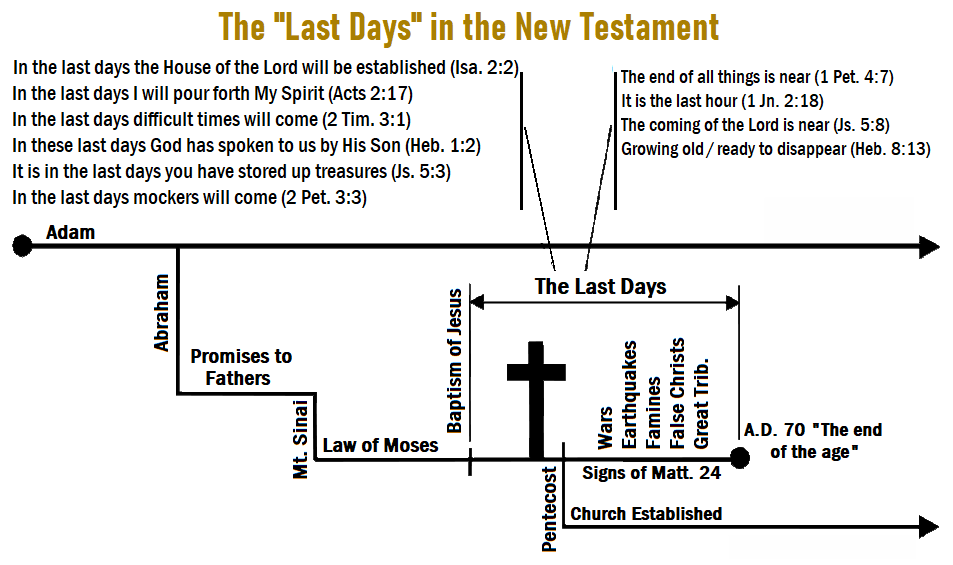
The last days are not a future period of time leading up to the rapture of the church and the end of the world. Nor are the last days describing the full contemporary Christian era. It hardly seems consistent to associate the term “days” with two millennia of years! A closer look at the New Testament usage of the term will reveal that the last days represented a now historical period of time. It was a fitting description of the final days of the Old Covenant, a period lasting a little over forty years. The first century earthly ministry of Jesus ushered in these last days. In this way, the “last days” of the New Testament were actually the “first days” of the New Testament church.1

The prophet Joel described some miraculous activities that would characterize the last days (Joel 2:28-31). The apostle Peter used the prophetic words of Joel to explain the miraculous events that were occurring at that time (Acts 2:16-17). The fact that those events were ascribed as being a fulfillment of the words of Joel indicated that the last days had arrived. If the inspired prophet was referencing the entire Christian era from Pentecost until the present, would we not expect these same miraculous activities to still be genuinely occurring — “in the last days”?2

It is sometimes said that the whole period between the incarnation and the end of the world is regarded in the New Testament as ‘the end of the age’, but this bears a manifest incongruity in its very front. How could the end of a period be a long protracted duration? Especially how could it be longer than the period of which it is the end? More time has already elapsed since the incarnation than from the giving of the law to the first coming of Christ: so that, on this hypothesis, the end of the age is a great deal longer than the age itself.3

Those Last Days Now Past

“God, who at various times and in various ways spoke in time past to the fathers by the prophets, has in these last days spoken to us by His Son…” (Hebrews 1:1)

A video presentation by a prominent creationist ministry, which promotes a biblical view of the earth’s age over and against the uniformitarian “millions of years” view, takes in to account the catastrophic effects of the global flood as recorded in the book of Genesis. However, the impact of the otherwise excellent production is weakened as the presenter states that today’s secular scientists whom disregard Scripture’s record of the Genesis flood are examples of the “scoffers” which the apostle Peter wrote would come in “the last days” (cf. 2 Peter 3:3-6). The devastating problem with this statement is that the inspired apostle wrote those words in the 1st century when the last days of the old covenant were at hand; so that the last days referred to were then, not now.

This is a major interpretive error made by modern-day Christians, which has become well ensconced in many hearts and minds, especially with the high volume of book sales along with seminary teachings by authors and professors based on the misapplication of the past to our present and near future. It is as if someone were to write in broad, non-specific terms about the last days of the Obama federal administration when they were (thankfully) nearing, and someone were to read it two thousand years or so from then, and assume the dynamics of the situation described to be directly applicable to the reader there and then, instead of relevant to the U.S.A. in the year of our Lord 2016.

When it comes to the Holy Bible which is the word of God, surely there is far-reaching application as well as eternal truth to be gleaned, but the correct interpretation must be gathered based upon the historical context and the understanding of the original audience. The last days from two thousand years ago cannot be the same last days today, or they would not have been the last days then. The realization that the “last days” were in the past, and that much of Bible prophecy (not all!) was fulfilled in the 1st century is key to sound discernment of the Scriptures.

Holy writ indeed informs us that the Lord Jesus Christ is reigning now. Peter also quoted Psalm 110:1 and said Jesus is exalted at God’s right hand (position of authority), to rule from the Majesty on High (cf Acts 2:34-36; Hebrews 1:3). Jesus Himself said, just prior to His ascension, “All authority has been given to Me in heaven and on earth” (Matthew 28:18). Hence, He is now King at God’s right hand, just as the Psalm prophesied. The apostle Paul further expounded that He must reign till He has put all enemies under His feet. The last enemy that will be destroyed is death (1 Corinthians 15:25-26). This has not happened yet, and of course we cling to the blessed hope of the resurrection of the body when the end comes and Jesus returns bodily in final judgment and to usher in the eternal state. Until then, the almighty, Triune God we serve is certainly to be victorious in time and history.

So the Messianic kingdom has already been established, i.e. we are in the “millennium” now. The last days of the old covenant, including the great tribulation prophesied in Matthew chapter 24, were the days leading up to and including the destruction of the temple, the city of Jerusalem and apostate Israel when the Son of Man “came” with judgment in 70 AD. “The last days” are now in the past, and followed from the work that He “finished” in 30 AD (cf John 19:30). The once for all sacrifice of the Lamb of God has superseded the old system of animal sacrifices, and now its up to the church, with steadfast faith in the power of the Holy Spirit, to look forward to and work towards the building of the kingdom on earth as it is in heaven… for, also as it is written, the earth will be filled with the knowledge of the glory of the LORD, as the waters cover the sea (Habakkuk 2:14).

The effectiveness of biblical apologetics as well as the fruitfulness of Christian cultural engagement efforts will be greatly increased by our faithful witness to the truth that the last days are in the past. The long haul to triumph will likely extend beyond the relatively short lifetimes of those of us alive today; there’s no time to waste. Let’s get busy using our talents in good and faithful service to our King (cf Matthew 25:23), leaving an example for future generations to follow. Keep the faith. Stand strong in the Truth. The worst is past and the best is yet to come.

– – – –

1 John M. Buttrey II, The Book of Revelation – A Brief Commentary and study Guide
2 Ibid
3 James Stuart Russell, The Parousia – The New Testament Doctrine of Christ’s Second Coming*
*Russel’s work teaches that Christ’s Second Coming took place in 70 AD, at which time the dead saints were resurrected and caught-up to Heaven, and the living saints were bodily caught-up to Heaven 😮. Even while not concurring with that startling conclusion, one can appreciate the many astute observations Russell makes such as the “manifest incongruity” of the end of the age being longer than the age of which it is the end of; akin to the “last days” lasting for thousands of years.

May 22, 2022

New Heavens and a New Earth (and a Book Review)

Matthew 24:35

Nounepiphany [ih-pif-uh-nee]
1. A divine manifestation
2. A moment of sudden understanding or revelation

We should all be on a quest to grow in grace through the renewing of our minds, seeking increased understanding of the pure, precious and perfect word of God. It is an amazing blessing when He embeds in us the zeal for such an effort, the reward of which can nearly amount to an ongoing epiphany.

As we humble ourselves and faithfully ask for God the Holy Spirit of Truth to guide us in the Way, fervent study of the Scriptures transforms us wonderfully. Not to say that true Christians cannot legitimately arrive at differing interpretations of holy writ but submitting to the Bible as a whole, beyond one’s systematic presuppositions, is essential to correctly perceive its teaching and be enlightened thereby.

Matthew 24 Fulfilled by John L. Bray includes personal testimony of the author’s journey through his changing perspectives on eschatology. A verse by verse commentary on our Lord’s teaching in what is commonly called the Olivet discourse as delineated in the “little apocalypse” of Matthew chapter 24, it is not so technical as to exclude the Christian layperson from appreciating it. The volume very effectively incorporates the parallel gospel accounts as well as cross references from the Old Testament in the discussion. Perhaps the most valuable benefit of the work is the extensive bibliography. Multitudinous and sundry resources are not only cited but quoted copiously, several of which are older and out of print or otherwise obscure to today’s inquiring minds. That it is available in PDF makes it even more of a worthy addition to one’s library, since in that format the many works referenced can be bookmarked for instant retrieval. With the support of many well-known older writers, including John Owen and Milton Terry, as well as many not so well-known older and newer ones, Bray ably presents the preterite perspective (he informs us that “preterist” is the noun whereas “preterite” is the adjective) of the “end times” teaching of the Bible.

The preterite perspective takes Christ at His word when He said “Assuredly, I say to you, this generation will by no means pass away till all these things take place.” (Matthew 24:34), indicating that everything He had foretold up to that point in​ His discourse would have a near term fulfillment, certainly within the lifetimes of some of those who were alive at that time. It does not attempt to apply any etymological alchemy to alter the time frame as stated, in order to accommodate ​a preconceived ​​futurist interpretation of the prophesy.

Having completed this comprehensive study, I am more convinced than ever not only of the complete fulfillment of the entirety of Matthew 24, but also that the references to “new heavens and a new earth” in Isaiah 65:17 and elsewhere foretell of the present gospel age and not the eternal state hereafter. Isaiah 51:16 says “And I have put My words in your mouth; I have covered you with the shadow of My hand, That I may plant the heavens, lay the foundations of the earth, and say to Zion, ‘You are My people.’ “ which refers not literally to the physical creation 3,000 years earlier but symbolically to the establishment of old covenant Israel; the very same “heavens and earth” that would pass away in A.D. 70 as foretold by Jesus in the Olivet discourse (Matthew 24:35) and subsequently also by Peter in his second epistle: “But the day of the Lord will come as a thief in the night, in which the heavens will pass away with a great noise, and the elements will melt with fervent heat; both the earth and the works that are in it will be burned up.” (2 Peter 3:10). It h​as become​ clear to me that Peter referred not to a physical destruction of the universe at the end of time but to that cataclysmic event of the Lord’s coming in judgment in those “last days”. The apostle then goes on to tell his 1st century readers “Nevertheless we, according to His promise, look for new heavens and a new earth in which righteousness dwells.” (2 Peter 3:13), which was couched in the same symbolic language to represent the establishment of the new covenant, having done away with the old.

The critical thing to understand is that while this prophecy was near in the future for those old covenant Jews who recognized the Messiah’s first advent and were converted, we are now looking back on it with joy as new covenant Christians born/reborn and living under the new covenant, in the “new heavens and earth” of this gospel age. When Jerusalem was destroyed, the temple and its ordinances, which were types and shadows, were done away with. This happened within the generation of the original hearers of the prophecy. Since then the church is the new dwelling place of God, and we now worship Him in Spirit and in Truth. The new covenant church is the new bride of the Lamb, the new Jerusalem, a new heaven and a new earth (cf Revelation 21:1).

No doubt this is a radical shift in perspective from the futurist mindset pervading the church today, which pushes already fulfilled prophesy into the “not yet” of our future. The Bible says nothing about a rebuilt physical temple despite the popularity of dispensational premillennialism. The modern mindset seems to have developed a natural aversion to the preterite understanding of Bible prophecy, and embracing a biblically sound, historical viewpoint requires a prayerful focus on determining what sayeth the Scriptures rather than expecting them to validate preconceptions made popular by the rise of dispensationalism only since the 19th century.

While the tide of eschatological consensus may be turning, a remaining obstacle to a hermeneutically sound, historical understanding of Scripture is the fear of going too far so as to depart from orthodoxy traditionally adhered to by the church (and some do!). In that regard let me hasten to affirm that there will be one great, final, visible, glorious, personal Coming of our Lord Jesus Christ (cf 1 Thessalonians 4 and 1 Corinthians 15), to coincide with universal, physical resurrection and judgment. This blessed hope is cherished even as we find that Scripture teaches there are also other ways in which He comes.

Read Matthew 24 Fulfilled (only $10 in PDF) which compellingly exonerates the preterite perspective of Bible prophecy, going no further than where it can be exegetically shown to apply. As John L. Bray did at the end of that work, I herewith quote what Dr. Milton S. Terry wrote (1898) in his book Biblical Apocalyptics:

…it is important to observe that the preterist and historical method of interpretation followed in this volume conserves the substance of every fundamental doctrine of the Gospel of Christ. It may helpfully modify some current conceptions of “the great and notable day of the Lord,” for it treats the imagery of collapsing skies, and falling stars, and sounding trumpets, and dissolving mountains, and great white throne, and scores of similar figures of thought as expressing great realities, but not spectacular physical phenomena. Our interpretation no more denies or sets aside the doctrines of eternal judgment, of heaven and hell, of resurrection of the dead, and the coming and kingdom of Christ than does the refusal to affirm the literal “fire and brimstone” of future retribution deny or invalidate the doctrine of eternal reward and punishment beyond this mortal life.

Nearly nineteen centuries of the manifested power and glory of Christianity in the world ought to have thrown some light on the nature of the coming and the kingdom of Christ. It can scarcely be a question among intelligent believers in Christ that the beginning of the era of our Lord and Saviour was the most signal and significant epoch in the history of mankind. It marked a “fullness of times,” a crisis of ages. The exact point of transition from the old to the new may be with many an open question. But whether we place it at the birth of Jesus or at the time of ​His crucifixion, when ​He cried, “It is finished,” or at ​His resurrection, or at ​His ascension, or at Pentecost, or at the fall of Jerusalem, the great commanding fact is still before us that the manifestation of the Christ, with which all these events must ever appear in vital relation, opened a new era in human civilization.

We now submit the thought that these nineteen centuries of Christian light and progress are relatively but the misty morning twilight of the great day of Christ. It may be that ​He must reign a thousand times a thousand years before he shall have put all his enemies under his feet (1 Cor. xv, 25).

The coming of Christ in ​His kingdom and power and glory is not one instantaneous act or event. It is a long-continuing process comprehensive of ​His entire work both of redemption and of judgment. He comes in the power of his Spirit to convict the world respecting sin and righteousness and judgment (John xvi, 8); ​He comes in like manner to forgive the sins of the penitent and to lead the disciple into all the truth; ​He comes and is present wherever two or three are gathered together in ​His name. He has been coming through all the Christian centuries to receive unto ​Himself the faithful souls who have looked for ​His heavenly appearing and glory (John xiv, 3; xvii, 22–24). As truly as Jehovah came of old in the clouds of heaven to execute judgment on the Egyptians (lsa. xix, 1), so did the Son of man come in the clouds and with the angels of ​His power to execute judgment on the great city that was guilty of ​His blood and drunken with the blood of ​His saints and martyrs. He sitteth at the right hand of Power and sendeth forth continually ​His innumerable company of angels to minister for them that shall inherit salvation…1

Just like in the days of Noah when the entirety of the evil society of mankind was destroyed, the wicked generation of apostate Israel was obliterated along with all the elements of the old covenant “heavens and earth”.

The Messianic reign of the Lord Jesus Christ will continue with the inexorable advancement of His kingdom until all His enemies are under His feet (cf. 1 Cor. 15:25) …and then He shall come again, bodily (cf. Acts 1:11), at the end of time to judge both the living and the dead.

My constant prayer is for a clearer, more widespread understanding of Messianic prophecy and its historical fulfillment. Recognition of this revealed truth leads ​immediately​ to the question, “How then should we live?”. Fresh understanding and appreciation of our blessed position in Christ is critically significant for a more positive outlook and a more practical application of the gospel in the everyday life of Christians and the church in the new covenant here and now. We are not on a sinking ship where it is futile to polish the brass; that’s how it was for old covenant Israel in the years just prior to 70 AD. We are the church militant in the kingdom of Christ which has come in power and glory, which must grow until it fills the earth. The Messianic reign of the Lord Jesus Christ will continue with the inexorable advancement of His kingdom until all His enemies are under His feet (cf. 1 Cor. 15:25) …and then He shall come again, bodily (cf. Acts 1:11), at the end of time to judge both the living and the dead. God’s people just need to be enlightened and exhorted to greater faith and obedience; perhaps the first step in that direction is for the scales to fall from our eyes.

For the earth will be filled with the knowledge of the glory of the LORD, as the waters cover the sea. (Habakkuk 2:14)

—-

[1] Terry, M. S. (1898). Biblical Apocalyptics: A Study of the Most Notable Revelations of God and of Christ in the Canonical Scriptures.