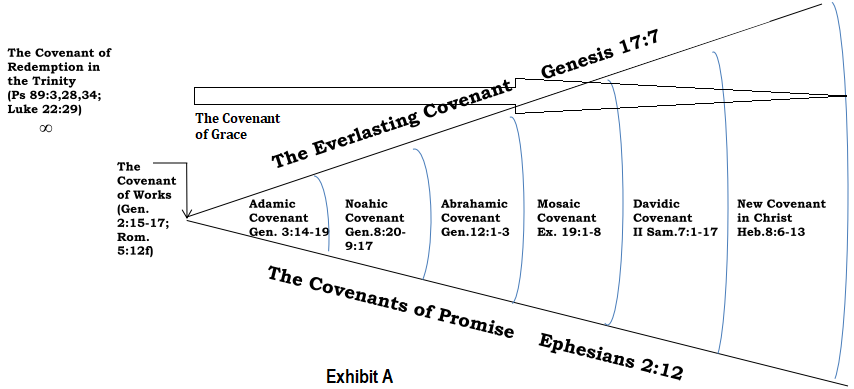
It has been said that we must know where we have been in order to understand where we are going. The canon of Scripture provides us with a God-breathed historical record of His covenantal decree from creation to consummation. Exhibit A below visualizes this:
Biblical scholars have recognized distinct periods in the life and times of God’s people as chronicled in holy writ. The timeline shown below (Exhibit B) delineates fifteen historical periods:

As our understanding of time and history continues to grow, even as we grow in grace and knowledge of our Lord and Savior Jesus Christ, the historical periods of the Bible may be expressed thusly, with sixteen historical periods leading to the eternal state, as per Exhibit C:

Exhibit B omits the historical period from the Lord’s ascension to the “days of vengeance” (cf. Luke 21:22) which is distinctly identified in the Scriptures (e.g. Daniel 9:26-27), and is the particularly frequent subject of New Testament prophecy. The omission of this period ignores the Lord’s prophetic focus on the generation then living. Dispensationalist / sensationalist influence may have led to extending those last days throughout the entire church age (millennia) up until the second coming, with the end of them somehow being continually imminent.
Exhibit C properly distinguishes the last days of the old covenant age with its animal sacrifices, etc., that finally passed away with the destruction of the temple in 70AD. The new testament corpus is irrefutably clear on this: the last days were then, as the end was at hand. Not the end of time as written of in 1 Corinthians 15:24 which takes place upon completion of the church/gospel age; but rather, the end at hand was the passing away of the “heaven and earth” of the old covenant age (cf. Isaiah 51:15-16).
Applying “last days” to the church age is more and more problematical as sensationalist predictions have failed to materialize for almost two millennia so far; besides which the Lord Jesus Christ, who is reigning now, must reign until all His enemies are under His feet (cf. 1 Corinthians 15:25) before the end comes.
This historical interpretation does not represent a novel understanding, and in no way denies or sets aside the creedal doctrines of the second coming of Christ at the end of time for the universal resurrection of bodies and eternal judgment for all who ever lived. As the church continues to shuffle off the “we are now living in the last days” paradigm, the words expressed by astute theologians are beginning to gain traction towards this biblical understanding:
Here’s Albert Barnes from his commentary on Hebrews 6:5: …and have tasted the good word of God and the powers of the age to come…:
the powers of the world to come – Or of the “coming age.” “The age to come” was a phrase in common use among the Hebrews, to denote the future dispensation, the times of the Messiah…
Here it evidently refers to that period, and the meaning is, that they had participated in the special blessings to be expected in that dispensation – to wit, in the clear views of the way of salvation, and the influences of the Holy Spirit on the soul.
The word “powers” here implies that in that time there would be some extraordinary manifestation of the “power” of God. An unusual energy would be put forth to save people, particularly as evinced by the agency of the Holy Spirit on the heart. Of this “power” the apostle here says they of whom he spake had partaken. They had been brought under the awakening and renewing energy which God put forth under the Messiah, in saving the soul. They had experienced the promised blessings of the new and last dispensation; and the language here is such as appropriately describes Christians, and as indeed can be applicable to no other.
Here’s John M. Buttrey II from his brief commentary on Revelation:
The last days are not a future period of time leading up to the rapture of the church and the end of the world. Nor are the last days describing the full contemporary Christian era. It hardly seems consistent to associate the term “days” with two millennia of years! A closer look at the New Testament usage of the term will reveal that the last days represented a now historical period of time. It was a fitting description of the final days of the Old Covenant, a period lasting a little over forty years. The first century earthly ministry of Jesus ushered in these last days. In this way, the “last days” of the New Testament were actually the “first days” of the New Testament church.
And here’s Milton Terry, excerpted from Biblical Apocalyptics:
The period which preceded the coming of the Messiah was spoken of as this age; that which followed His [first] coming was the age to come.
…by this age they meant and could mean nothing else than the current period in which they were living, the then present age. The question of the disciples, as recorded [in Matthew 24:3], could therefore only refer to the pre-Messianic age, and its consummation was, as we have seen, associated in their thought with the overthrow of the temple. But even were it admitted that their notion of “the consummation of the age” was erroneous, the teaching of Jesus was emphatic beyond all rational question that that generation should not pass away before all those things of which they inquired should be fulfilled.
The age to come, the Messianic time, would accordingly be the period that would follow immediately after the termination of the pre-Messianic age. That time had not yet come when Jesus spoke. According to the whole trend of New Testament teaching that age and the Messianic kingdom were near or at hand. Christ’s ministry fell in the last days of an aeon.
Lastly here’s Ralph Bass, from his commentary on Revelation:
And He who sits on the throne said, “Behold, I am making all things new.” And He said, “Write, for these words are faithful and true.” The phrase, behold, I am making all things new (Rev. 21:5) is interpreted by most as the beginning of the eternal state. We posit a millennium, which moves the world increasingly toward this eternal state with the increasing victory of the Church, but does not ultimately confuse the one with the other. Symbolic language pictures our spiritual victories and looks forward to material benefits in earthly prosperity and health. But the earthly millennium is never to be confused with heaven itself.
The effectiveness of biblical apologetics as well as the fruitfulness of Christian cultural engagement efforts will be greatly enhanced by our increased discernment of the times, and our corresponding faithful witness to the truth of what has been, is now, and is to come; that the last days as written of in the New Testament are in our past, and that our commission as “the church militant” advancing the gospel under the authority of the Lord Jesus Christ, and by the power of the Holy Spirit, is clear.
The long haul to triumph will likely extend beyond the relatively short lifetimes of those of us alive today; there’s no time to waste. Let’s get busy using our talents in good and faithful service to our King (cf Matthew 25:23), leaving an example for future generations to follow. Keep the faith. Stand strong in the Truth.
~
Also see: Scripture References: The Gospel Age and The Eternal State


 churchvictory