Posts tagged ‘“last days”’

April 12, 2024

Discerning the Times

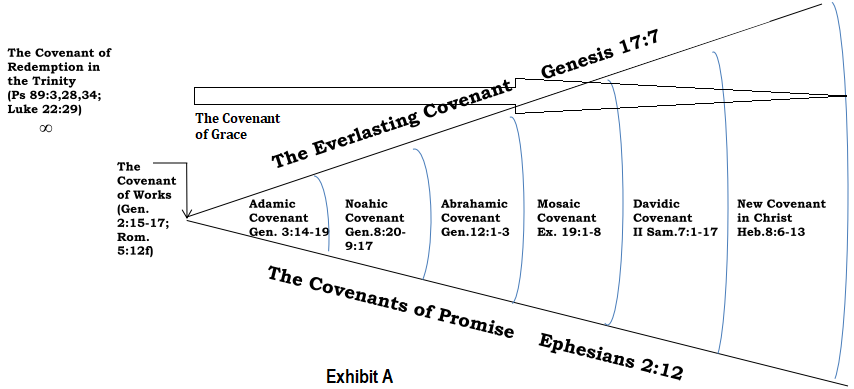
It has been said that we must know where we have been in order to understand where we are going. The canon of Scripture provides us with a God-breathed historical record of His covenantal decree from creation to consummation. Exhibit A below visualizes this:

Biblical scholars have recognized distinct periods in the life and times of God’s people as chronicled in holy writ. The timeline shown below (Exhibit B) delineates fifteen historical periods:


As our understanding of time and history continues to grow, even as we grow in grace and knowledge of our Lord and Savior Jesus Christ, the historical periods of the Bible may be expressed thusly, with sixteen historical periods leading to the eternal state, as per Exhibit C:


Exhibit B omits the historical period from the Lord’s ascension to the “days of vengeance” (cf. Luke 21:22) which is distinctly identified in the Scriptures (e.g. Daniel 9:26-27), and is the particularly frequent subject of New Testament prophecy. The omission of this period ignores the Lord’s prophetic focus on the generation then living. Dispensationalist / sensationalist influence may have led to extending those last days throughout the entire church age (millennia) up until the second coming, with the end of them somehow being continually imminent.

Exhibit C properly distinguishes the last days of the old covenant age with its animal sacrifices, etc., that finally passed away with the destruction of the temple in 70AD. The new testament corpus is irrefutably clear on this: the last days were then, as the end was at hand. Not the end of time as written of in 1 Corinthians 15:24 which takes place upon completion of the church/gospel age; but rather, the end at hand was the passing away of the “heaven and earth” of the old covenant age (cf. Isaiah 51:15-16).

Applying “last days” to the church age is more and more problematical as sensationalist predictions have failed to materialize for almost two millennia so far; besides which the Lord Jesus Christ, who is reigning now, must reign until all His enemies are under His feet (cf. 1 Corinthians 15:25) before the end comes.

This historical interpretation does not represent a novel understanding, and in no way denies or sets aside the creedal doctrines of the second coming of Christ at the end of time for the universal resurrection of bodies and eternal judgment for all who ever lived.  As the church continues to shuffle off the “we are now living in the last days” paradigm, the words expressed by astute theologians are beginning to gain traction towards this biblical understanding:

Here’s Albert Barnes from his commentary on Hebrews 6:5: …and have tasted the good word of God and the powers of the age to come…:

the powers of the world to come – Or of the “coming age.” “The age to come” was a phrase in common use among the Hebrews, to denote the future dispensation, the times of the Messiah…

Here it evidently refers to that period, and the meaning is, that they had participated in the special blessings to be expected in that dispensation – to wit, in the clear views of the way of salvation, and the influences of the Holy Spirit on the soul.

The word “powers” here implies that in that time there would be some extraordinary manifestation of the “power” of God. An unusual energy would be put forth to save people, particularly as evinced by the agency of the Holy Spirit on the heart. Of this “power” the apostle here says they of whom he spake had partaken. They had been brought under the awakening and renewing energy which God put forth under the Messiah, in saving the soul. They had experienced the promised blessings of the new and last dispensation; and the language here is such as appropriately describes Christians, and as indeed can be applicable to no other.

Here’s John M. Buttrey II from his brief commentary on Revelation:

The last days are not a future period of time leading up to the rapture of the church and the end of the world. Nor are the last days describing the full contemporary Christian era. It hardly seems consistent to associate the term “days” with two millennia of years! A closer look at the New Testament usage of the term will reveal that the last days represented a now historical period of time. It was a fitting description of the final days of the Old Covenant, a period lasting a little over forty years. The first century earthly ministry of Jesus ushered in these last days. In this way, the “last days” of the New Testament were actually the “first days” of the New Testament church.

And here’s Milton Terry, excerpted from Biblical Apocalyptics:

The period which preceded the coming of the Messiah was spoken of as this age; that which followed His [first] coming was the age to come.

…by this age they meant and could mean nothing else than the current period in which they were living, the then present age. The question of the disciples, as recorded [in Matthew 24:3], could therefore only refer to the pre-Messianic age, and its consummation was, as we have seen, associated in their thought with the overthrow of the temple. But even were it admitted that their notion of “the consummation of the age” was erroneous, the teaching of Jesus was emphatic beyond all rational question that that generation should not pass away before all those things of which they inquired should be fulfilled.

The age to come, the Messianic time, would accordingly be the period that would follow immediately after the termination of the pre-Messianic age. That time had not yet come when Jesus spoke. According to the whole trend of New Testament teaching that age and the Messianic kingdom were near or at hand. Christ’s ministry fell in the last days of an aeon.

Lastly here’s Ralph Bass, from his commentary on Revelation:

And He who sits on the throne said, “Behold, I am making all things new.” And He said, “Write, for these words are faithful and true.” The phrase, behold, I am making all things new (Rev. 21:5) is interpreted by most as the beginning of the eternal state. We posit a millennium, which moves the world increasingly toward this eternal state with the increasing victory of the Church, but does not ultimately confuse the one with the other. Symbolic language pictures our spiritual victories and looks forward to material benefits in earthly prosperity and health. But the earthly millennium is never to be confused with heaven itself.

The effectiveness of biblical apologetics as well as the fruitfulness of Christian cultural engagement efforts will be greatly enhanced by our increased discernment of the times, and our corresponding faithful witness to the truth of what has been, is now, and is to come; that the last days as written of in the New Testament are in our past, and that our commission as “the church militant” advancing the gospel under the authority of the Lord Jesus Christ, and by the power of the Holy Spirit, is clear.

The long haul to triumph will likely extend beyond the relatively short lifetimes of those of us alive today; there’s no time to waste. Let’s get busy using our talents in good and faithful service to our King (cf Matthew 25:23), leaving an example for future generations to follow. Keep the faith. Stand strong in the Truth.

~

Also see: Scripture References: The Gospel Age and The Eternal State

April 23, 2023

Fallacious Notions – Temporal Displacement


What if the same controligarchs behind the gaslighting of the general populace have intentionally corrupted the Church’s understanding of the word of truth — the Holy Scriptures? Their objective being the establishment and popularization of distorted theology towards the advancement of their globalist agenda and neutering the church militant. It was largely achieved via the publication of a Bible with explanatory notes presenting delusory interpretations of the text:

“…Cyrus Scofield, a forger, felon and trained lawyer, had been hired by the Rothschilds to write this dispensational reinterpretation of biblical events and Christian doctrine.” …

”The writing and promotion of “Scofield’s Reference Bible” was a massive effort to subvert true Christianity to serve Zionist/NWO interests…

“Throughout the 20th Century and with incredible support from the Rothchild controlled Oxford Press, various editions of Scofield’s Bible would actually create a new religion, Christian Zionism (Judeo-Christianity), altering words and meanings through deceptive footnotes.”

– Merlin L. Miller1

First published in 1909 and still available today, the Scofield Notes have systematized a fanciful, invalid exposition of Scripture, serving the agenda of wicked globalists the likes of which are now being exposed more and more as the great democide of the 2020s unfolds.

One minister who broke with Scofieldism described it as a “subtle, intriguing heresy”.2

Thankfully, the unscriptural teaching of a literal, earthly Jewish kingdom, with all the associated temporal deceptions (e.g. inserting a “gap” of time in to the seventy weeks prophecy of Daniel 9:24-27) has come to be largely rejected. Even so, erroneous understandings of Bible prophecy, exacerbated by dispensational seminary teachings and media sensationalism, remain ingrained in the church at large, to the detriment of the gospel’s advancement.

Not rightly dividing the Scriptures in their historical context has led to a general “temporal displacement” in the understanding of eschatology, typically manifested by removing passages from their native context, i.e. the time period when they were written, and interpreting them as if they are written contemporaneously to the generation presently living.

Thus, in the minds of many, near-at-hand prophecies which were fulfilled accordingly in that 1st century generation, have remained unfulfilled and somehow continually imminent for almost 2 millennia now.

“The End is Near”

 “The end of all things” which was at hand when the apostle Peter wrote of it (1 Peter 4:7) refers, in its proper context, to the passing away of the old covenant as per Hebrews 8:13: In that He says, “A new covenant,”  He has made the first obsolete. Now what is becoming obsolete and growing old is ready to vanish away. The civil state of the Jews, their sacrifices, temple, city and nation would soon be gone. Of course, physical death, which is indeed the end of all things in this world, is always near at hand to any particular person, but the literal end of the physical world was clearly not near at hand nor in view in this passage.

Neither can the apocalyptic language of the book of Revelation prophesying the days of vengeance on the Harlot (apostate Judaism) and the Beast (Rome) be rightfully construed as foretelling an end of the cosmos at the end of time, since the events were foretold shortly before they were to take place (Revelation 1:1; 22:6). Just like the apocalyptic imagery of judgment in 2 Peter 3:10-13, the prophesied events were near-at-hand then.

Furthermore, the end of time is not near now. In this gospel age, the present millennial reign of our ascended Lord will continue until He puts an end to all rule and all authority and power. For He must reign till He has put all enemies under His feet (1 Corinthians 15:24-25). We rightfully expect that the earth will be filled with the knowledge of the glory of the Lord as the waters cover the sea (Isaiah 11:9; Habakkuk 2:14) before the end.

“Heaven and Earth will literally pass away”

The Bible teaches that, at the end of this church age, the presently bound Satan will be released for a short time (Rev. 20:3) to deceive the nations again and mount a rebellious army which is crushed as, in the apocalyptic language of the vision, “fire from heaven came down and consumed them” (Revelation 20:9). This does not mean that the creation itself will be destroyed by being burned up! The creation itself is being redeemed from the curse, not headed for dissolution, as it is written:

For the earnest expectation of the creation eagerly waits for the revealing of the sons of God. For the creation was subjected to futility, not willingly, but because of Him who subjected it in hope; because the creation itself also will be delivered from the bondage of corruption into the glorious liberty of the children of God. (Romans 8:20-21)

The crafty deception that the earth will be destroyed at the end of time is perhaps the most critical of all fallacious eschatological notions, and is at the root of many others.

Jesus’ statement that “Heaven and earth will pass away…” (Matthew 24:35) cannot be interpreted to refer to the physical cosmos without violating the analogy of faith, i.e. there can be no essential contradictions in the Scriptures. To wit:

The literal earth is determined to not pass away. In Psalm 104:5 David said that God “laid the foundation of the earth, that it shall not be removed forever.” And in Ecclesiastes 1:4 Solomon said, “One generation passes away, and another generation comes: but the earth abides forever.”

“And He built His sanctuary like high palaces, like the earth which He has established forever.” (Psalm 78:69).

“Praise Him, ye heavens of heavens, and ye waters that be above the heavens… “He has also established them for ever and ever: He has made a decree which shall not pass” (Psalm 148:4,6).

God promised after the flood that He would never again “strike down every living creature as I have done.” (Genesis 8:21). This, it is thought, does not rule out God’s destruction of the entire world by fire someday, and that 2 Peter 3:10 teaches this. But no, with the phrase “as I have done” the LORD attests to His power and majesty in His manner of declaration, not to give Himself a “loophole” to smite everything living again but in a different manner, which might be a laughable consideration if not so irreverently preposterous.

It would be a blatant contradiction if God was to burn up the elements, meaning atoms & molecules according to the literalistic misinterpretation of the prophetic language of 2 Peter 3:10.3  Besides, the apocalyptic destruction Peter wrote of was near at hand when he wrote in the last days of the old covenant.

Thus in light of the full counsel of Scripture, our Lord’s statement that “heaven and earth will pass away” cannot be interpreted literally in the context of Matthew 24:35. Rather, especially in consideration of the prophetic idiom being used, the reference is to the old covenant and its temple system (the house left desolate) just as it is in 2 Peter 3:10.

Jesus had also said “…assuredly, I say to you, till heaven and earth pass away, one jot or one tittle will by no means pass from the law till all is fulfilled.” (Matthew 5:18). The ceremonial ordinances were finally abrogated when the temple was destroyed, the Lamb of God having fulfilled all of the sacrificial typology.

Conclusively, the reference to the “passing away of heaven and earth” must be considered in light of the establishment of that same “heaven and earth” in Isaiah 51: 15-16:

”I am the LORD your God, Who divided the sea whose waves roared — The LORD of hosts is His name. And I have put My words in your mouth; I have covered you with the shadow of My hand, That I may plant the heavens, lay the foundations of the earth, and say to Zion, ‘You are My people.’”

The LORD was not depicting the original physical creation 3,000 years previously, but rather the establishment of the old (Mosaic) covenant upon bringing His people out of Egypt. (cf. Jeremiah 31:32).

“The Great Tribulation is Yet to Come”

Great tribulation may indeed be expected for present and future generations, especially as God’s people stand for the truth of God’s word in a culture of decadence and tyranny. Even so, Jesus’ prophecy that then there will be great tribulation, such as has not been from the beginning of the world until now, no, and never will be (Matthew 24:21) was declared in no uncertain terms to take place before the generation then living would pass away.

The book of Revelation, which apocalyptically presents the undiluted wrath of God poured out on that wicked generation, was written by the apostle John as a fellow partaker in that tribulation with the original hearers of the letter (Rev. 1:9). From our historical perspective, the events which happened then manifestly align with the things signified to John in the Apocalypse shortly before they were to take place as per the “temporal bookends” of Rev. 1:1 and Rev. 22:6.

The works of Jewish historian Josephus document the events of the great tribulation which took place in the time leading up to and including the destruction and desolation of the old covenant temple in 70 AD.

For a concise, highly readable record of those now historical events see George Halford’s The Destruction of Jerusalem. Judgment fell heavily upon that generation in those “days of vengeance” in vindication of the Lord Jesus Christ.

“No one knows the day or hour”

When predicting His coming in judgment (via the Roman armies) on apostate Judaism, the Lord stated, “But of that day and hour no one knows…” (Matthew 24:36). This He declared not in reference to His Second Coming at the end of time, rather, in context, the reference is to the day and hour of His near coming in judgment of which He was prophesying.

No one knew exactly when the Temple would be utterly destroyed and the Jewish age of sacrifice finished. But they were given warning signs:  when you see Jerusalem surrounded by armies, then know that its desolation is near (Luke 21:20) and more importantly, the general time by when it would take place: within that generation!

While it is true that the day and hour of the Second Coming of Christ (cf. Hebrews 9:26-28) remains unknown to mankind, the temporal markers in the text of the Olivet discourse in Matthew 24 (and parallels) do not authorize direct application of the saying to that great, final, end-of-time event which Christians ought to hopefully expect in accordance with God’s timetable, when all His enemies have been put under His feet, which may not happen within the lifetimes of anyone reading this now.

Not to dare prognosticate on this matter, but it looks like a long term proposition, as God gathers in the multitudes of His elect. Let us hasten the day by advancing the gospel that it may flourish in ours and future generations towards the final consummation of all things.

“Satan is the god of this age”

An “age” is a period of time. There is no other age that will follow the present age of Christ’s mediatorial reign (what the New Testament, written prior to the termination of the Old Covenant age with the fall of Jerusalem4, refers to as “the age to come”). We are now in the final age of time and history, as the ascended Lord Jesus Christ reigns in majesty on high at the right hand of the Father.

Satan is NOT “the god of this age” that we are in now. Satan was the god of an age that was passing away. He was “the god of this age” when the apostle Paul wrote 2 Cor. 4:4; Gal. 1:4; Rom. 16:20, etc. Jesus crushed Satan’s head and bound him in the first century (cf. Matt. 12:29; Luke 10:18; Rev. 20:2; etc.).

Not to say that the evil one is not still active other than in wholesale deception of the nations the way he was before, but the Lord Jesus Christ is reigning now and in the process of putting all His enemies under His feet (cf. Ps. 2; Ps. 110; Dan. 7:13-14; 1Cor. 15:25; etc.) and we are instrumental in the process.

Let us not let temporal displacement of the texts of Scripture be a rationale to expect defeat in time and history in the battle against evil, as we fight for and with the Way, the Truth and the Life.

For everyone who has been born of God overcomes the world. And this is the victory that has overcome the world—our faith. (1 John 5:4)

~

Christian Zionism – Scofield Rothchild Puppet

Why I Left Scofieldism

3 Passing Away… – A Study of 2 Peter 3

4 Before Jerusalem Fell

May 27, 2022

The Last from the Past

The last days are not a future period of time leading up to the rapture of the church and the end of the world. Nor are the last days describing the full contemporary Christian era. It hardly seems consistent to associate the term “days” with two millennia of years! A closer look at the New Testament usage of the term will reveal that the last days represented a now historical period of time. It was a fitting description of the final days of the Old Covenant, a period lasting a little over forty years. The first century earthly ministry of Jesus ushered in these last days. In this way, the “last days” of the New Testament were actually the “first days” of the New Testament church.1

The prophet Joel described some miraculous activities that would characterize the last days (Joel 2:28-31). The apostle Peter used the prophetic words of Joel to explain the miraculous events that were occurring at that time (Acts 2:16-17). The fact that those events were ascribed as being a fulfillment of the words of Joel indicated that the last days had arrived. If the inspired prophet was referencing the entire Christian era from Pentecost until the present, would we not expect these same miraculous activities to still be genuinely occurring — “in the last days”?2

It is sometimes said that the whole period between the incarnation and the end of the world is regarded in the New Testament as ‘the end of the age’, but this bears a manifest incongruity in its very front. How could the end of a period be a long protracted duration? Especially how could it be longer than the period of which it is the end? More time has already elapsed since the incarnation than from the giving of the law to the first coming of Christ: so that, on this hypothesis, the end of the age is a great deal longer than the age itself.3

Those Last Days Now Past

“God, who at various times and in various ways spoke in time past to the fathers by the prophets, has in these last days spoken to us by His Son…” (Hebrews 1:1)

A video presentation by a prominent creationist ministry, which promotes a biblical view of the earth’s age over and against the uniformitarian “millions of years” view, takes in to account the catastrophic effects of the global flood as recorded in the book of Genesis. However, the impact of the otherwise excellent production is weakened as the presenter states that today’s secular scientists whom disregard Scripture’s record of the Genesis flood are examples of the “scoffers” which the apostle Peter wrote would come in “the last days” (cf. 2 Peter 3:3-6). The devastating problem with this statement is that the inspired apostle wrote those words in the 1st century when the last days of the old covenant were at hand; so that the last days referred to were then, not now.

This is a major interpretive error made by modern-day Christians, which has become well ensconced in many hearts and minds, especially with the high volume of book sales along with seminary teachings by authors and professors based on the misapplication of the past to our present and near future. It is as if someone were to write in broad, non-specific terms about the last days of the Obama federal administration when they were (thankfully) nearing, and someone were to read it two thousand years or so from then, and assume the dynamics of the situation described to be directly applicable to the reader there and then, instead of relevant to the U.S.A. in the year of our Lord 2016.

When it comes to the Holy Bible which is the word of God, surely there is far-reaching application as well as eternal truth to be gleaned, but the correct interpretation must be gathered based upon the historical context and the understanding of the original audience. The last days from two thousand years ago cannot be the same last days today, or they would not have been the last days then. The realization that the “last days” were in the past, and that much of Bible prophecy (not all!) was fulfilled in the 1st century is key to sound discernment of the Scriptures.

Holy writ indeed informs us that the Lord Jesus Christ is reigning now. Peter also quoted Psalm 110:1 and said Jesus is exalted at God’s right hand (position of authority), to rule from the Majesty on High (cf Acts 2:34-36; Hebrews 1:3). Jesus Himself said, just prior to His ascension, “All authority has been given to Me in heaven and on earth” (Matthew 28:18). Hence, He is now King at God’s right hand, just as the Psalm prophesied. The apostle Paul further expounded that He must reign till He has put all enemies under His feet. The last enemy that will be destroyed is death (1 Corinthians 15:25-26). This has not happened yet, and of course we cling to the blessed hope of the resurrection of the body when the end comes and Jesus returns bodily in final judgment and to usher in the eternal state. Until then, the almighty, Triune God we serve is certainly to be victorious in time and history.

So the Messianic kingdom has already been established, i.e. we are in the “millennium” now. The last days of the old covenant, including the great tribulation prophesied in Matthew chapter 24, were the days leading up to and including the destruction of the temple, the city of Jerusalem and apostate Israel when the Son of Man “came” with judgment in 70 AD. “The last days” are now in the past, and followed from the work that He “finished” in 30 AD (cf John 19:30). The once for all sacrifice of the Lamb of God has superseded the old system of animal sacrifices, and now its up to the church, with steadfast faith in the power of the Holy Spirit, to look forward to and work towards the building of the kingdom on earth as it is in heaven… for, also as it is written, the earth will be filled with the knowledge of the glory of the LORD, as the waters cover the sea (Habakkuk 2:14).

The effectiveness of biblical apologetics as well as the fruitfulness of Christian cultural engagement efforts will be greatly increased by our faithful witness to the truth that the last days are in the past. The long haul to triumph will likely extend beyond the relatively short lifetimes of those of us alive today; there’s no time to waste. Let’s get busy using our talents in good and faithful service to our King (cf Matthew 25:23), leaving an example for future generations to follow. Keep the faith. Stand strong in the Truth. The worst is past and the best is yet to come.

– – – –

1 John M. Buttrey II, The Book of Revelation – A Brief Commentary and study Guide
2 Ibid
3 James Stuart Russell, The Parousia – The New Testament Doctrine of Christ’s Second Coming*
*Russel’s work teaches that Christ’s Second Coming took place in 70 AD, at which time the dead saints were resurrected and caught-up to Heaven, and the living saints were bodily caught-up to Heaven 😮. Even while not concurring with that startling conclusion, one can appreciate the many astute observations Russell makes such as the “manifest incongruity” of the end of the age being longer than the age of which it is the end of; akin to the “last days” lasting for thousands of years.

May 27, 2022

The End of the Last Days

NounEnd [​end]
-the point in time at which something ends;
-the concluding parts of an event or occurrence​;
​-the state of affairs that a plan is intended to achieve and that (when achieved) terminates
 behavior intended to achieve it​

In Acts 2:17ff the apostle Peter declares the fulfilment of the inspired words of the prophet Joel​: “And in the last days it shall be, God declares…”. The events foretold happened in those “last days.” The spectacular fire baptism by the Holy Spirit, daughters prophesying, etc. along with all the cosmic judgment language depicting the then at hand destruction of old covenant Israel all happened then, and is now over and done with. Your daughters are not prophesying any more, for example. As those last days ended and are in our past, I believe that we are not now still living in the last days.

Amillennialists such as James White maintain a concept of “this age, and the age to come”, that the age we are living in now is a continuation of the “last days” spoken of by the apostles, and the age to come is the hereafter, i.e. final glory. Surprisingly, postmillennialist Ken Gentry agrees that the last days, which began in the first century, continue through now and on into the future, until the end of time, which understanding requires that the “last days” have now lasted for approximately 2 millennia, so far. One wonders if Dr. Gentry, who anticipates a long period of Christian prosperity before the second coming, presumes that the “last days” will remain in effect all that time.

That there will be a triumph of the gospel of the Lord Jesus Christ manifesting in time and history should be the Christian’s faithful hope, according to His word; but it is a result of His first coming which ended the last days of the old covenant. “In that He says, ‘A new covenant,’ He has made the first obsolete. Now what is becoming obsolete and growing old is ready to vanish away” (Hebrews 8:13).

The old covenant age was from Moses until Christ. Christ brought in the new covenant, such that Dr. White’s “this age” was actually the old covenant age, which was passing away when the New Testament was written; and his “age to come” is actually the here & now of the new creation, the gospel age, the Messianic reign of the Lord Jesus Christ, the millennium of Revelation 20, the new Jerusalem, the new heaven & earth (in an already/not yet sense). Final glory is not an age in time & history, rather it comes after the end of the ages for us. The end of the ages for the New Testament writers was then.

​The Greek word aion is commonly translated as world, as in Hebrews 11:3 which the NKJV renders: “By faith we understand that the worlds were framed by the word of God, so that the things which are seen were not made of things which are visible.” The Greek word there translated as worlds is aiones (plural of aion). This passage describes our faith in the providence of God in the works of creation. However aion can also mean “age”, and application of the wrong connotation can be the cause of considerable misunderstanding.

The apostle Paul, in referring to the old covenant, wrote “Now these things happened to them as an example, but they were written down for our instruction, on whom the end of the ages has come” (1 Corinthians 10:11). While Jesus’ first advent marked the beginning of the new covenant age, the old covenant age was finally swept away in AD 70. There was a transitional period of about 40 years (a generation) from AD 30 to AD 70 in which the two ages co-existed. Those were the “last days”. It was towards the end of this period when the apostle Peter wrote “The end of all things is at hand…” (1 Peter 4:7).

The writer of Hebrews confirmed this in contrasting the types & shadows of the old covenant with redemption through the blood of Christ: “For Christ has entered, not into holy places made with hands, which are copies of the true things, but into heaven itself, now to appear in the presence of God on our behalf. Nor was it to offer Himself repeatedly, as the high priest enters the holy places every year with blood not his own, for then He would have had to suffer repeatedly since the foundation of the world. But as it is, He has appeared once for all at the end of the ages to put away sin by the sacrifice of Himself (Hebrews 9:24-26).

​Jesus Himself mentioned the ages when he said “And whoever speaks a word against the Son of Man will be forgiven, but whoever speaks against the Holy Spirit will not be forgiven, either in this age or in the age to come” (Matt. 12:32). Surely the age He distinguished as “this age” had to be the old covenant age, under which He was born and was ministering; while the “age to come” was a reference to the new covenant gospel age which He came to bring in. The “age to come” as a reference to the hereafter makes no sense because everyone’s eternal state is fixed and it is too late for repentance and forgiveness for any sin.

Here’s Matthew Henry’s commentary on the unpardonable sin passage:

  • What the sentence is that is passed upon it; It shall not be forgiven, neither in this world, nor in the world to come. As in the then present state of the Jewish church, there was no sacrifice of expiation for the soul that sinned presumptuously; so neither under the dispensation of gospel grace, which is often in scripture called the world to come, shall there be any pardon to such as tread underfoot the blood of the covenant, and do despite to the Spirit of grace: there is no cure for a sin so directly against the remedy. 

Even so, in Luke 20:34-36 Jesus says “The children of this world marry, and are given in marriage. But they which shall be accounted worthy to obtain that world, and the resurrection from the dead, neither marry, nor are given in marriage. Neither can they die any more, for they are equal unto the angels; and are the children of God, being the children of the resurrection.” The KJV properly renders aion as “world” in each instance where it appears in this passage, which is reasonably preferred over “age” as in modern translations (see NKJV). Translating aion as “age” in this context may have led to misunderstanding the New Testament writer’s “age to come” as the eternal state.

We must let context determine the correct connotation of words for sound interpretation of God’s infallible word. The sooner Christians embrace by faith that we are living under the better blessings of the new covenant age as distinct from the last days of the old covenant, which have ended, the sooner we will put off the expectation of defeat; and, walking by faith and not by sight, will trust, obey, pray, think and act accordingly towards advancing the kingdom of our reigning King of kings and Lord of lords, Jesus Christ, towards that end. Amen.


[See “Last Days” tab / sub-tabs above for timeline and graphical representations of the two-age model, with commentary beneath each]