Posts tagged ‘Chronology’

April 12, 2024

Discerning the Times

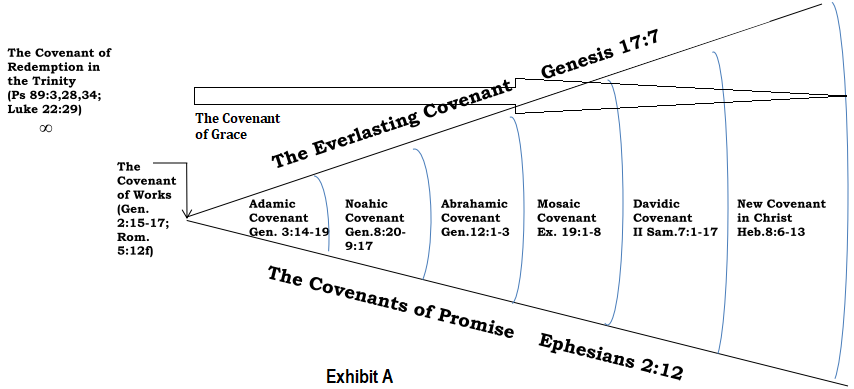
It has been said that we must know where we have been in order to understand where we are going. The canon of Scripture provides us with a God-breathed historical record of His covenantal decree from creation to consummation. Exhibit A below visualizes this:

Biblical scholars have recognized distinct periods in the life and times of God’s people as chronicled in holy writ. The timeline shown below (Exhibit B) delineates fifteen historical periods:


As our understanding of time and history continues to grow, even as we grow in grace and knowledge of our Lord and Savior Jesus Christ, the historical periods of the Bible may be expressed thusly, with sixteen historical periods leading to the eternal state, as per Exhibit C:


Exhibit B omits the historical period from the Lord’s ascension to the “days of vengeance” (cf. Luke 21:22) which is distinctly identified in the Scriptures (e.g. Daniel 9:26-27), and is the particularly frequent subject of New Testament prophecy. The omission of this period ignores the Lord’s prophetic focus on the generation then living. Dispensationalist / sensationalist influence may have led to extending those last days throughout the entire church age (millennia) up until the second coming, with the end of them somehow being continually imminent.

Exhibit C properly distinguishes the last days of the old covenant age with its animal sacrifices, etc., that finally passed away with the destruction of the temple in 70AD. The new testament corpus is irrefutably clear on this: the last days were then, as the end was at hand. Not the end of time as written of in 1 Corinthians 15:24 which takes place upon completion of the church/gospel age; but rather, the end at hand was the passing away of the “heaven and earth” of the old covenant age (cf. Isaiah 51:15-16).

Applying “last days” to the church age is more and more problematical as sensationalist predictions have failed to materialize for almost two millennia so far; besides which the Lord Jesus Christ, who is reigning now, must reign until all His enemies are under His feet (cf. 1 Corinthians 15:25) before the end comes.

This historical interpretation does not represent a novel understanding, and in no way denies or sets aside the creedal doctrines of the second coming of Christ at the end of time for the universal resurrection of bodies and eternal judgment for all who ever lived.  As the church continues to shuffle off the “we are now living in the last days” paradigm, the words expressed by astute theologians are beginning to gain traction towards this biblical understanding:

Here’s Albert Barnes from his commentary on Hebrews 6:5: …and have tasted the good word of God and the powers of the age to come…:

the powers of the world to come – Or of the “coming age.” “The age to come” was a phrase in common use among the Hebrews, to denote the future dispensation, the times of the Messiah…

Here it evidently refers to that period, and the meaning is, that they had participated in the special blessings to be expected in that dispensation – to wit, in the clear views of the way of salvation, and the influences of the Holy Spirit on the soul.

The word “powers” here implies that in that time there would be some extraordinary manifestation of the “power” of God. An unusual energy would be put forth to save people, particularly as evinced by the agency of the Holy Spirit on the heart. Of this “power” the apostle here says they of whom he spake had partaken. They had been brought under the awakening and renewing energy which God put forth under the Messiah, in saving the soul. They had experienced the promised blessings of the new and last dispensation; and the language here is such as appropriately describes Christians, and as indeed can be applicable to no other.

Here’s John M. Buttrey II from his brief commentary on Revelation:

The last days are not a future period of time leading up to the rapture of the church and the end of the world. Nor are the last days describing the full contemporary Christian era. It hardly seems consistent to associate the term “days” with two millennia of years! A closer look at the New Testament usage of the term will reveal that the last days represented a now historical period of time. It was a fitting description of the final days of the Old Covenant, a period lasting a little over forty years. The first century earthly ministry of Jesus ushered in these last days. In this way, the “last days” of the New Testament were actually the “first days” of the New Testament church.

And here’s Milton Terry, excerpted from Biblical Apocalyptics:

The period which preceded the coming of the Messiah was spoken of as this age; that which followed His [first] coming was the age to come.

…by this age they meant and could mean nothing else than the current period in which they were living, the then present age. The question of the disciples, as recorded [in Matthew 24:3], could therefore only refer to the pre-Messianic age, and its consummation was, as we have seen, associated in their thought with the overthrow of the temple. But even were it admitted that their notion of “the consummation of the age” was erroneous, the teaching of Jesus was emphatic beyond all rational question that that generation should not pass away before all those things of which they inquired should be fulfilled.

The age to come, the Messianic time, would accordingly be the period that would follow immediately after the termination of the pre-Messianic age. That time had not yet come when Jesus spoke. According to the whole trend of New Testament teaching that age and the Messianic kingdom were near or at hand. Christ’s ministry fell in the last days of an aeon.

Lastly here’s Ralph Bass, from his commentary on Revelation:

And He who sits on the throne said, “Behold, I am making all things new.” And He said, “Write, for these words are faithful and true.” The phrase, behold, I am making all things new (Rev. 21:5) is interpreted by most as the beginning of the eternal state. We posit a millennium, which moves the world increasingly toward this eternal state with the increasing victory of the Church, but does not ultimately confuse the one with the other. Symbolic language pictures our spiritual victories and looks forward to material benefits in earthly prosperity and health. But the earthly millennium is never to be confused with heaven itself.

The effectiveness of biblical apologetics as well as the fruitfulness of Christian cultural engagement efforts will be greatly enhanced by our increased discernment of the times, and our corresponding faithful witness to the truth of what has been, is now, and is to come; that the last days as written of in the New Testament are in our past, and that our commission as “the church militant” advancing the gospel under the authority of the Lord Jesus Christ, and by the power of the Holy Spirit, is clear.

The long haul to triumph will likely extend beyond the relatively short lifetimes of those of us alive today; there’s no time to waste. Let’s get busy using our talents in good and faithful service to our King (cf Matthew 25:23), leaving an example for future generations to follow. Keep the faith. Stand strong in the Truth.

~

Also see: Scripture References: The Gospel Age and The Eternal State

May 27, 2022

Chronology, Creation and Compromise (includes a Movie Review)

The year is 1890 and Bible professor Russell Carlisle (D. David Morin) has written a new manuscript entitled “The Changing Times.” His book is about to receive a unanimous endorsement from the board members of the Grace Bible Seminary until his colleague Dr. Norris Anderson (Gavin Macleod) raises an objection. Dr. Anderson believes that Carlisle’s writing could greatly affect future generations. Using a secret time machine, Anderson sends Carlisle over 100 years into the future, offering him a glimpse of where his beliefs will lead.

As is obvious from the above plot description appearing on the back of the DVD case, the movie Time Changer (a Rich Christiano film) is a work of fiction. Absent of high-budget special effects, and with a Christian theme, it has not reached anywhere near popular blockbuster status. Nevertheless, the film makes the enduring case for steadfast adherence to the authority of the Word of God. Carlisle’s manuscript makes a plea for morality and righteousness but begs the question, “By what standard?”. Anderson objects to the teaching of the law apart from the law-Giver, of preaching morality apart from the authority of the Word of God.

After finally submitting to Anderson’s insistence, Carlisle travels to the future where he sees the disastrous results of mankind’s rejection of the infallible standard of righteousness, the Lord Jesus Christ. Apart from Him no one is righteous, no – not one. In one scene, Carlisle tells a hot dog snatching girl that it is not right to steal, and the girl responds “Says who?”.

In another scene in the movie, Carlisle, in the future (the year 2000), perceived that he was in the “end times” and commented that therefore Jesus must be coming shortly to “set up His kingdom on earth”. This of course is indicative of a premillennial view of eschatology (end times). To anyone reading this blog who is at all familiar with eschatology, it must be apparent by now that here we embrace a postmillennial view, which is that the bodily return of the Lord Jesus (“the second coming”) will take place after His kingdom has been well established here on earth during this present age. While premillennialism does not detract from the excellent message of the film, the eschatological viewpoint of Christ returning a “millennium” before the final judgment, with the resurrection of believers when He comes, and then another resurrection of unbelievers at the end of His earthly reign is a problematical interpretation of Scripture mainly because it is out of accord with biblical chronology.

A greatly overlooked passage of Scripture which presents us a timetable of end time events is 1 Corinthians 15:25-26: For He must reign till He has put all enemies under His feet. The last enemy that will be destroyed is death. The context is Christ’s reign in heaven, which is where He sits at the right hand of Majesty on High since His ascension. Death is destroyed (general resurrection) at the end – at the last day – in a moment, the twinkling of an eye (1 Corinthians 15:52), not a prolonged drama for 1,000 years. So all of the enemies of the Lord Jesus Christ and His church are being put under His feet, and then comes the end, when death is destroyed. “The logic of Paul is inescapable” as per respected theologian B.B. Warfield.

Other key texts of Scripture teach one particular day of resurrection/judgment for all which takes place when Jesus comes back (cf Acts 17:31; Acts 24:15 ). There will be a day of resurrection and judgment for ALL men – when Jesus comes. Do not marvel at this; for the hour is coming in which all who are in the graves will hear His voice and come forth — those who have done good, to the resurrection of life, and those who have done evil, to the resurrection of condemnation (John 5:28-29). Notwithstanding that it may be the most widely held eschatological perspective in the church today, it can reasonably be said that the premillennial view of the book of Revelation is chronologically untenable based on unavoidable presuppositions derived from the full counsel of Scripture.

There is much more that can be said about end times chronology and the difficulties presented by the book of Revelation which is apocalyptic literature rendered in signs & symbols (the “first resurrection” of Revelation 20 is symbolic of spiritual regeneration!), but let us turn our chronometers from the end back to the beginning — to the book of Genesis and the creation account. Here we have clear-cut historical narrative, presenting the account of the magnificent work of almighty God creating all things ex nihilo (out of nothing) in six literal (24-hour) days. This is wonderful truth for the believer. Indeed the pattern for the days and weeks of our lives were thereby established. Our God is an awesome God! Just as we believe steadfastly in the virginal birth and bodily resurrection of our Lord Jesus Christ, we hold to a “young earth” as plainly depicted in the earliest history recorded in Genesis 1-11. We believe God’s word is inerrant and infallible, and we stand by its irrefutable truth as interpreted from the original language text in accordance with well established and scholarly accepted grammatical-historical methodology.1

The compromise comes in by what may be called the 3 Ws. That is, when a professing believer is either weak, wanting or wicked. The attack on God’s word is from the outside, in the form of the secular/humanist religion of evolution. Under the flag of so-called “science”, millions of years is presented for injection into the Bible’s chronology of creation. The weak accept it to avoid ridicule, or to get along. They fear men more than they fear God. The biblical worldview of others is compromised as they are wanting for a proper defense of the faith, and are overwhelmed by not having an answer to ungodly dogma presented as accepted fact. The wicked trample on the blood of Jesus, accepting the concept of death and sin before the fall, which overturns the gospel, promoting that lie to lead others astray. Make no mistake about it beloved, this is a foundational issue. Abortion, homosexuality, racism, adultery, broken families, attacks on the institution of marriage, and all such perversities are the symptoms of the undermining of the authority of God’s word.

So where do we go from here? Well first of all, if you have swallowed the wicked lie of evolution in any way, shape or form then I urge you to vomit it up and spit it out. Hold fast to your faith, and don’t be afraid to speak up. What position does your local church take on the inerrancy of God’s word? Has its leadership compromised on the creation account of the Bible? Take heart, eyes are being opened, minds are being renewed. God is giving zeal for His Truth to His people, and help is available! Go to the AnswersInGenesis website where you can arm yourself with reliable information and resources. Another excellent website is the Institute for Creation Research. Get yourself a copy of The Beginning of the World – A Scientific Study of Genesis 1-11 by Dr. Henry Morris (remember Kindle Edition books are less expensive and readable on any PC or MAC with the free reading app). Stay tuned for more…

Let us pray that things don’t have to get much worse before the church of the Lord Jesus Christ arises to insist that the Bible is authoritative for all of life, from beginning to end.

1 See Reformed Theology and Six Day Creation by Kenneth L. Gentry


But grow in grace, and in the knowledge of our Lord and Saviour Jesus Christ.
To Him be glory both now and for ever. Amen. (2 Peter 3:18)