
by Gordon Graham | Updated Sep 4 2024
The living, active word of God brings continual refreshment and renewal to our understanding as we seek to perceive its meaning in the historical context so as to rightly determine the application looking forward from there.
“For the Son of Man will come in the glory of His Father with His angels, and then He will reward each according to his works. –Matthew 16:27
In his commentary on this passage, Adam Clark wrote:
This seems to refer to Daniel 7:13-14:
“I kept looking in the night visions, and behold, with the clouds of heaven One like a Son of Man was coming, and He came up to the Ancient of Days and was presented before Him. And to Him was given dominion, glory and a kingdom, that all the peoples, nations and men of every language might serve Him. His dominion is an everlasting dominion which will not pass away; and His kingdom is one which will not be destroyed.” [NASB]
This was the glorious Mediatorial kingdom which Jesus Christ was now about to set up, by the destruction of the Jewish nation and polity, and the diffusion of His Gospel through the whole world… It is very likely that the words do not apply to the final judgment, to which they are generally referred; but to the wonderful display of God’s grace and power after the day of pentecost.
-Adam Clarke’s Commentary on the Bible | Adam Clarke, LL.D., F.S.A., (1715-1832) | Published in 1810-1826; public domain.
The context is the Lord’s “take up your cross and follow Me” teaching. Jesus encouraged His disciples to self-denial through sufferings, by comparing worldly afflictions with eternal life (cf Romans 8:18), and associating material gain with loss of immortal soul.
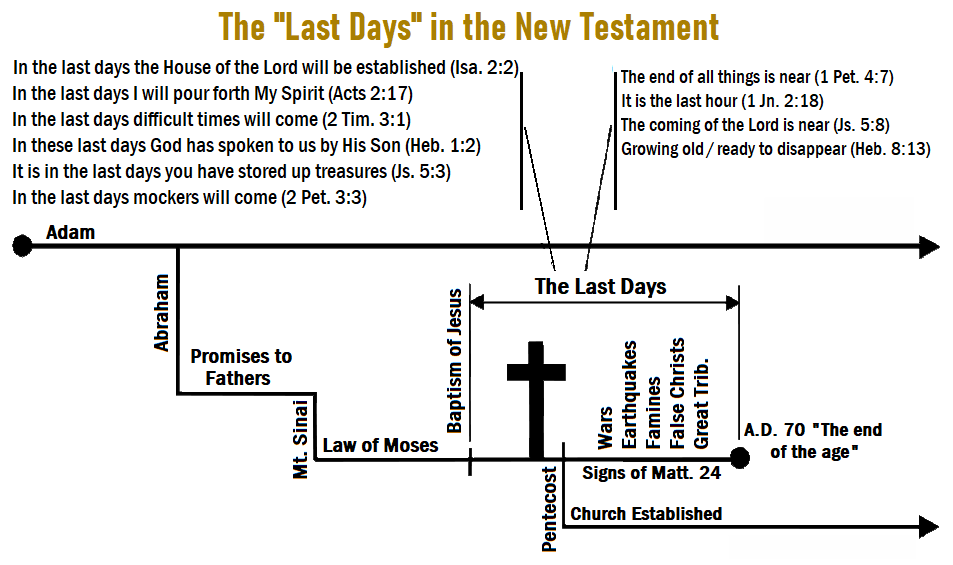
Then He foretells that He is “about to” [μέλλει / mellei] ascend to His throne in heaven where He sits at the right hand of the Father to “repay every man according to his deeds” as He did with the “days of vengeance” judgment on apostate Israel via the Roman armies in 70AD; and He continues to judge the world throughout His millennial reign until He has put all enemies under His feet. (cf. 1 Cor. 15:25).
Psalm 2 tells of the Messiah’s triumph and kingdom (note that in verse 6, by Zion is meant the church of God, especially in the gospel age under the New Covenant (cf. Heb. 12:22).
Gary DeMar’s analysis is helpful:
When these soon to take place judgments happened, God’s judgment was neither postponed nor stopped. They serve as warnings as Paul stated in 1 Corinthians 10:11: “Now these things happened to them [Old Covenant Israel] as an example [τύπος/type], and they were written for our instruction, upon whom the ends of the ages have arrived.” The “our instruction” refers to the people in Paul’s day related to the upcoming judgment on first-century Israel that took place in the lead up to and including the destruction of Jerusalem that happened in AD 70. All generations can learn from Israel’s moral mistakes as well as the moral mistakes of Rome, the French Revolution, the Soviet Union, Nazi Germany, and modern-day United States. No one is exempt from God’s judgment.1
Understanding Matthew 16:27 as referring to our Lord’s glorious ascension up to the heavenly Session of His millennial reign better reconciles the historical context with ongoing future application than does considering it solely in reference to either the days of vengeance now past, or to the future 2nd Coming at the end of time.2 In Acts 1:9, Jesus is described as being taken up into heaven on a cloud, which parallels the imagery in Daniel 7:13.
The inauguration of the resurrected, glorified Christ’s reign in heaven at His ascension takes into account the “already / not yet” aspect of fulfilled prophecy, while also recognizing that God’s judgment was not only in 70AD but is continuous throughout time and history until the consummation of all things.
Here’s additional insight from Gary DeMar:
It is important to note that the noun “preterism” has been squeezed too far back as if it is about nothing more than what is past, about completed action in the past with no future application. The New Testament does address the issue of preterism and acknowledges that certain prophetic announcements—such as Christ’s Olivet Discourse—have been fulfilled in the past. But there is more to consider. There is an important nuance that needs to be spelled out.
Let us get at it this way: Per the Greek, which verb tense best expresses what preterism is as the New Testament understands it? Is it merely the way the noun “preterism” is defined in a standard dictionary as simply referring to the past tense or is it the way the New Testament defines it? Only referring to the past tense and nothing more than that is not the best way to define what Biblical preterism is. The most accurate verb tense in the Greek to render what Biblical preterism really is [is] the perfect tense.
What is the difference between the standard past tense and this perfect tense? Like the standard past tense, the perfect tense also speaks of completed action in the past, BUT the perfect tense has much more nuance to it: The perfect tense in Greek speaks of completed action in the past whose consequences continue into the future by way of application. This is what true Biblical preterism is. It is very important to grasp this distinction. True preterism does not pit the past against the future. Rather, Biblical preterism organically unites the past and the future.3
In his commentary on Luke 19:13, And he called his ten servants, and delivered them ten pounds, and said unto them, “Occupy till I come”, Benson insightfully brings out the perfect tense structure of the passage covering past, present and future application:
And said unto them, occupy till I come — till I return to take an account of the use you have made of what has been intrusted to your management. The spiritual sense is, use your endowments, gifts, and graces, with all your privileges and advantages, for the good of your fellow-creatures, and the glory of God, till I come to visit the nation; to destroy Jerusalem; to execute judgment on my enemies, and on those of my people in successive ages; to require your souls of you by death, and to judge mankind in the day of final accounts.
-Joseph Benson’s Commentary on the Old and New Testaments
The coming and kingdom of Christ are not facts of of the future only, but of the past, present, and future. The crafty deception that messianic prophecy remains unrealized and ever looming in our near future opposes the biblical truth of fulfillment in and by the Lord Jesus Christ. False teachers feed the expectation of a fleshy messianic kingdom yet to be established on earth in accordance with the plague of scofieldian dispensationalism which has infected the church at large, even as it is both exegetically absurd and spiritually apostate.
As the wickedness of the modern day Zionist state of Israel is being exposed, awareness of the satanic conspiracy known as the ‘New World Order’4 is increasing. Scales are dropping from eyes. A “red pill” antidote compiled to counter Zionism’s long-term, pervasive brainwashing is available here.
Let us speak truth to power as the Light of the world shines unto eternal day.
1 Gary Demar, Does Isaiah 13 Predict the ‘End of the World’?, Jan 9 2024
2 Gorphilus DeJesus, Eschatology Between the Extremes, Dec 11 2022
3 Gary DeMar, So What Do We Do Now?, Jan 3 2024
4 Makia Freeman, Is the New World Order a Jewish Conspiracy? No, it’s a Satanic Conspiracy, Oct 14 2019
—-
Gordon Graham is a Ruling Elder in the Presbyterian Church in America and Clerk of Session at Auburn Road Presbyterian Church in Venice, FL. Husband of one wife, father and brother of two each, and brother in Spirit of many, he also writes under the pen name of Gorphilus DeJesus.
—-
~
 churchvictory